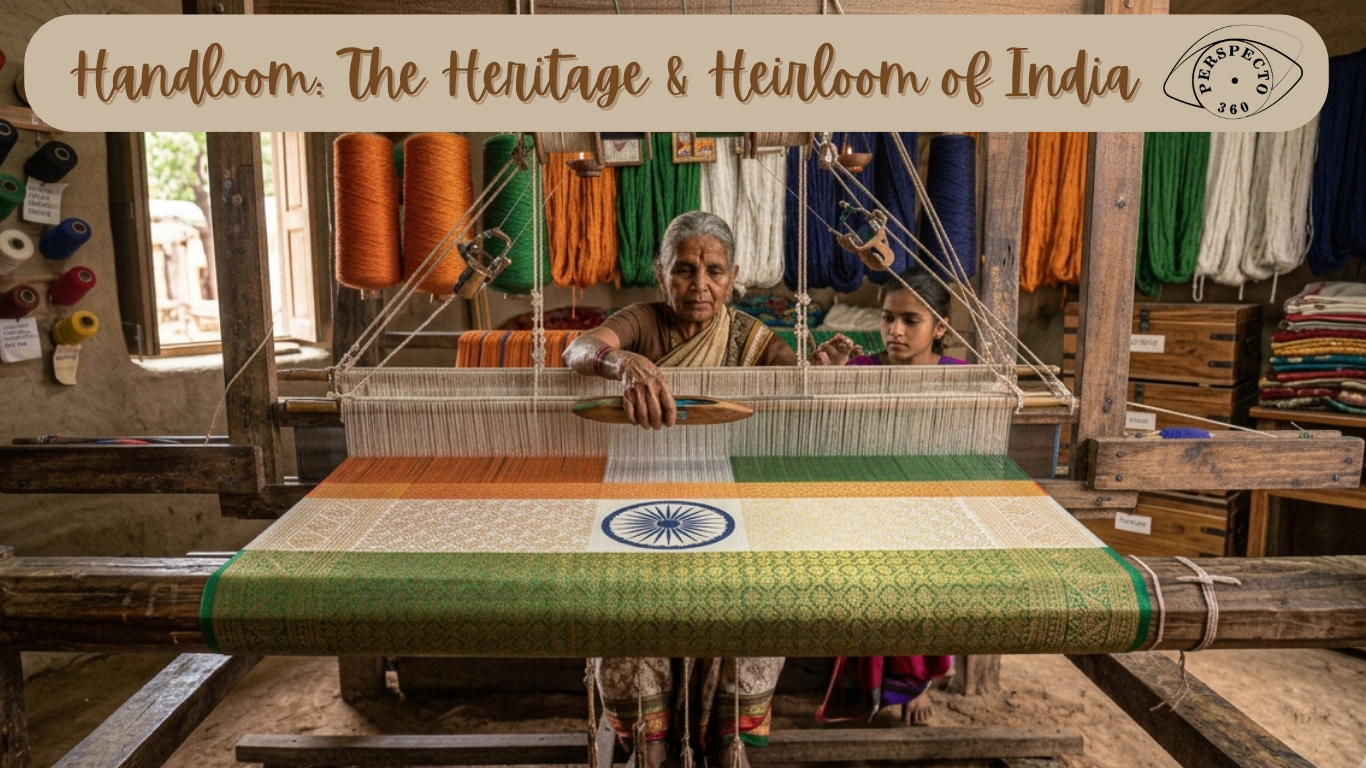
"Fast fashion ages in months; handloom turns into an heirloom. Invest in weaves that outlive trends."
India celebrates National hand loom Day every year on 7th August. Indians celebrate National hand loom Day each year to honor our weavers. We celebrate the day to preserve traditional textile practices. We also recognize hand loom’s contribution to the country’s social and economic development. This day also recognizes and commemorates with the swadeshi movement which started on 7 August 1905. The National Hand loom day was officially declared in 2015, and its first celebration was inaugurated in Chennai.
Fashion wouldn’t start on high-fashion runways—it started as pure survival. Adam and Eve sewed fig leaves into aprons, and ancient Egyptians developed fine flax linen around 2000 BC; garments originally served as our ‘second skin’ to protect against harsh climates. But today? Fashion has evolved into a medium of deep self-expression, encourage entrepreneurship, express identity, and an environmental responsibility.
What is a Handloom?
A handloom manually converts yarn into woven fabric. Unlike power looms, handlooms generally do not depend on electricity for the basic process of weaving. The weaver controls the movement of the yarns, shuttle and other parts of the loom like harnesses and reed with their hands and feet.
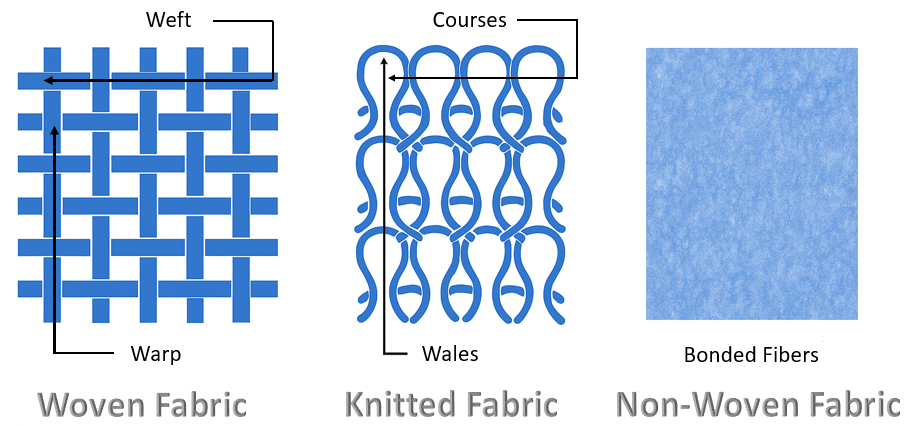
The two main sets of yarns used in weaving are the warp and the weft. The Weavers lay warp yarns lengthwise on the loom and stretch them tightly, while weft yarns pass across them with the help of a shuttle. As a result, interlacing these yarns in creatively different ways helps weavers produce fabrics with varied textures, patterns and designs. Handlooms rely entirely on human energy, skill, and rhythm. Every yarn carries the artisan’s signature. Additionally, it is more than fabric; it represents wearable art with a zero-carbon footprint in power consumption. They are therefore much more eco-friendly as compared to powerloom fabrics.
People value handloom fabrics for their individuality, authenticity and workmanship. Small variations in texture and color are a sign that the product is handmade and are not considered defects. They are signs of human craftsmanship. Every sari, shawl, carpet or piece of fabric carries the skill, patience and creative expression of the artisan who made it.
Importance of Handloom
Handloom is an important part of India’s cultural identity that preserves the traditional know-how of numerous vivid communities. Regional textiles such as Banarasi silk, Kanchipuram silk, Pashmina, Chanderi, Kota Doria, Jamdani, Ikat, Kalamkari and Pochampally represent the history and artistic traditions of diverse Indian states and their cultures.
The handloom sector is the second largest employment sector in India, after Agricultural Sector. It provides employment in rural and semi-rural areas of the country. It supports not only weavers but also spinners, artisans, dyers, hand printing workers, designers, embroiderers, traders and many other workers. Government describes handloom as an important source of livelihood, with women forming more than 70% of weavers and allied workers in the sector. (Source: National Handloom Day | MyGov)
Handloom production is also relatively eco-friendly. It requires less power (lowers carbon footprint) and is often based on local materials and skills (as per the location of the states). Since the process is usually slower than mass production, it encourages thoughtful consumption and supports the idea of sustainable and eco-friendly fashion.
The Handloom Process
The handloom fabric construction involves several careful stages, beginning with the selection of fiber and ending with the finished product. Because the process is intricate and time-consuming, the craftsman and artisans meticulously work on the design prerequisites. The process involved in manufacturing a handloom fabric are:
1. Selection of fiber and Yarn
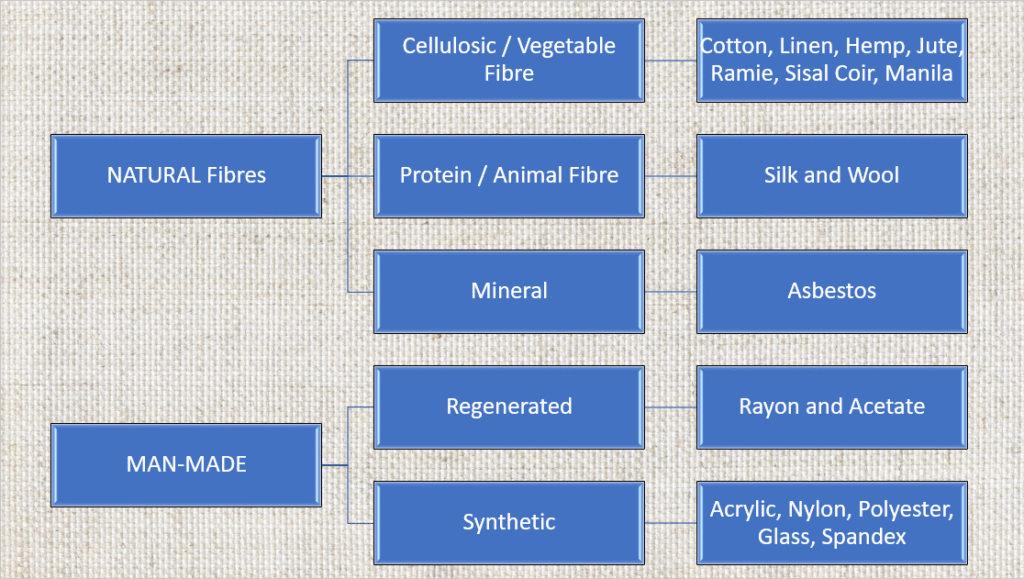
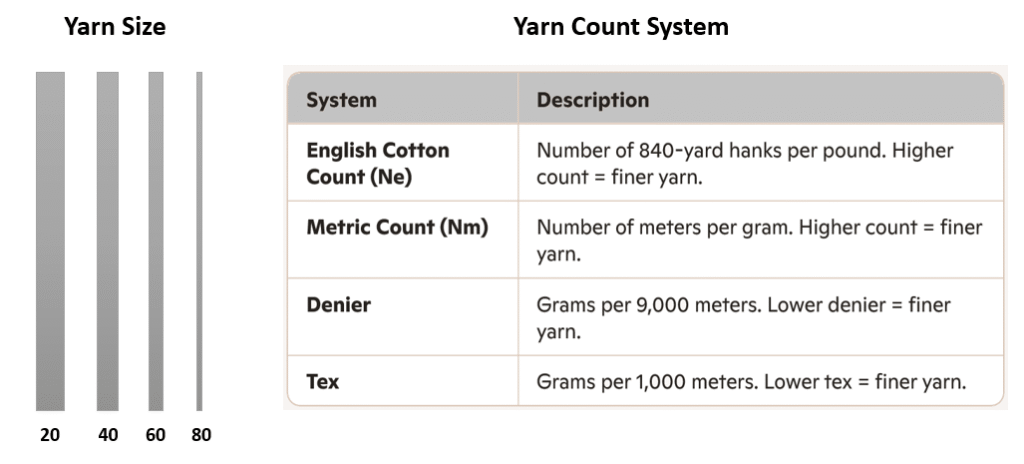
The process begins with choosing the fiber. The process uses cotton, silk, wool, linen, and blended fibers to suit the desired fabric. The fibers are cleaned, processed and spun into yarn. The quality, thickness and strength of the yarn influence the appearance and durability of the final textile material
2. Dyeing and Washing
Dyers color the yarn before weaving. Artisans choose either natural or chemical dyes to create the required colors. After dyeing, artisans wash and dry the yarn to finish the process. In some traditions, artisans keep the yarn undyed to retain the fiber’s natural color.
3. Winding and Warping
The yarns are then wound onto bobbins or reels. Next process is warping. Here the required number of warp yarns are arranged in parallel lines through the harness. These yarns are measured carefully, threaded through the harness carefully and placed on the warp beam of the loom.
4. Drafting and Denting
Each warp thread is passed through the heddles on the harnesses according to the woven design to be manufactured. It is then inserted through the reed, a comb-like part of a loom that maintains the spacing of the threads and avoids entanglement of yarns. This stage is known as drafting and denting. Accurate preparation is the most essential for producing an even fabric and a precise pattern.
5. Weaving
The weaver now begins to interlace the warp and weft yarns. A shuttle carries the weft yarn through the opening shed created between the warp threads. The weaver then uses the hand or foot mechanisms to change the position of the warp and beat the weft into place using a reed.
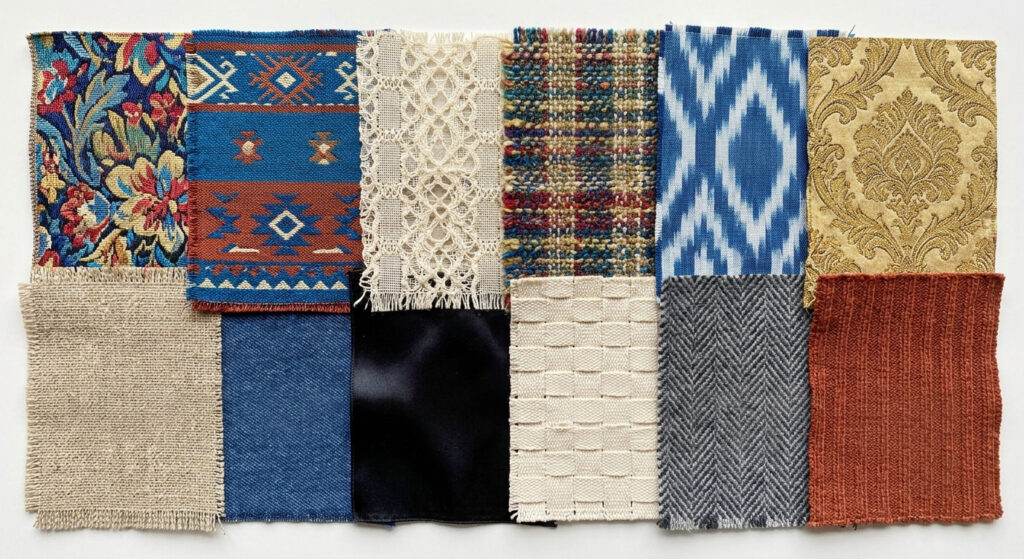
Plain weave, twill, satin, extra-weft designs, brocade and supplementary patterns can be created through different arrangements of threads. Throughout weaving, the artisan checks the tension, alignment, color and pattern to correct mistakes immediately.
6. Finishing
After the required length is woven, the fabric is removed from the loom. Loose threads are trimmed and the edges are secured. The material is then washed, softened, pressed, starched or polished. Finally, it is inspected for quality before being converted into a sari, garment, furnishing, stole or any other product.
Types of Handlooms
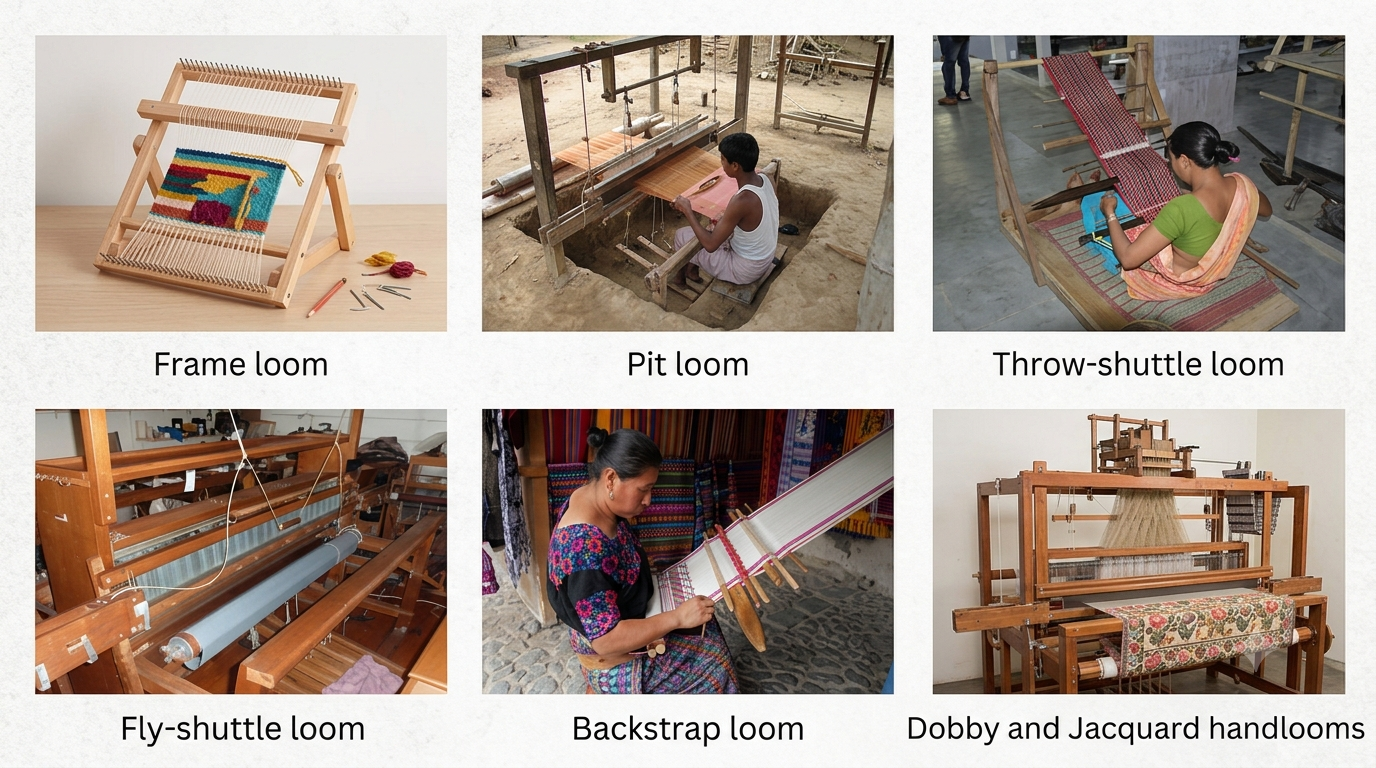
Handlooms with time evolved and changed. They differ from each other according to their structure, location and method of operation.
- Frame loom: A compact loom supported by a frame, often used for smaller fabrics and teaching.
- Pit loom: Installed over a pit in the ground, allowing the weaver to operate the pedals comfortably.
- Throw-shuttle loom: Uses a shuttle thrown from one side to the other and is suitable for comparatively narrow fabrics.
- Fly-shuttle loom: Uses a mechanical hand-operated arrangement that allows the shuttle to move quickly across a wider loom.
- Backstrap loom: A traditional loom in which one end is attached to a fixed point and the other is secured around the weaver’s body.
- Dobby and Jacquard handlooms: Create more complex geometric, floral and figured designs with the help of multiple harnesses or punch cards
Famous GI-Tagged Indian Handlooms
A Geographical Indication (GI) tag identifies products associated with a particular region, where their quality, reputation or special characteristics are linked to that place. For handloom textiles, it helps protect traditional weaving techniques, support authorised artisans and distinguish authentic products from imitations.
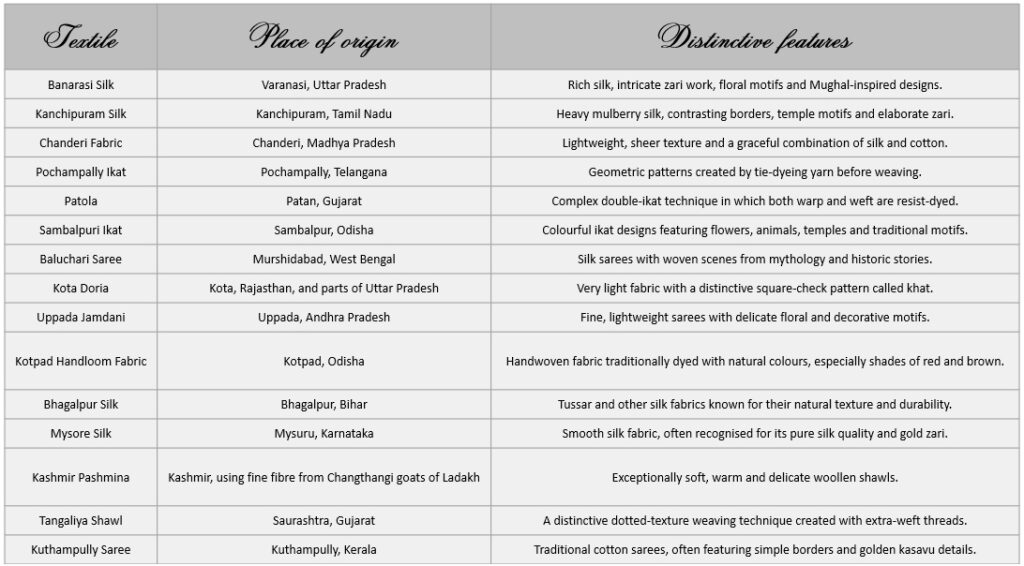
Banarasi Silk originates from Varanasi and is famous for its elaborate zari work, luxurious brocaded silk and finely woven motifs. Its designs reflect the influence of Indian floral traditions and Mughal decorative art. Banarasi silk received GI recognition in 2009.
Kanchipuram Silk, also called Kanjeevaram silk, comes from Kanchipuram in Tamil Nadu. It is known for its vibrant colours, strong silk, broad contrasting borders and temple-inspired motifs. In the traditional korvai method, the body and border are woven separately and then interlocked.
IKAT
Ikat is a resist-dyeing technique in which yarns are tied and dyed before they are placed on the loom. The designs emerge when the dyed warp and weft threads are carefully aligned during weaving.
Pochampally Ikat from Telangana is especially known for its bold geometric patterns. Odisha’s Sambalpuri Ikat, also known as Bandha, uses traditional motifs inspired by nature, temples and local culture. Odisha Ikat received GI recognition in 2006.
The Patola of Patan, Gujarat, is among India’s most intricate textiles. It uses a double-ikat technique, meaning that both the warp and weft are resist-dyed before weaving. Because the preparation and weaving require exceptional precision, authentic Patola sarees are highly valued.
Chanderi and Kota Doria
Chanderi fabric originated in the historic town of Chanderi in Madhya Pradesh. It is admired for its lightness, transparency and elegant texture. Traditionally made from silk and cotton, Chanderi is suitable for sarees, dupattas and dress materials.
Kota Doria is associated mainly with Kota in Rajasthan. Its airy texture and tiny square checks make it especially suitable for warm climates. The fabric is traditionally woven using a combination of cotton and silk, producing a light yet attractive textile.
Baluchari and Jamdani
Baluchari sarees originated in the Murshidabad region of West Bengal. The name is connected with Baluchar, an area where skilled weavers practised this tradition. Their most remarkable feature is the use of woven panels showing scenes from epics, mythology and courtly life.
Uppada Jamdani comes from Uppada village in Andhra Pradesh. It is a delicate, lightweight silk textile distinguished by finely woven decorative motifs. The Jamdani technique requires the insertion of additional threads to create patterns on the fabric’s surface.
Why These Textiles Matter?
GI-tagged handlooms preserve regional identity and provide recognition to the communities that created them. They also encourage consumers to look for authentic products and help protect traditional techniques from unauthorised imitation.
Each textile tells a story about its landscape, materials and people: Pashmina reflects the cold Himalayan environment, Patola represents technical mastery, Sambalpuri Ikat expresses Odisha’s cultural imagination and Kanchipuram silk celebrates South Indian temple traditions. Buying genuine GI-tagged handloom products is therefore both a cultural choice and a way of supporting India’s weavers and artisan communities.
From Tradition to Modernity
Handloom has changed significantly from its earliest forms. Ancient weavers worked with simple tools made of wood, bamboo and other locally available materials. Over time, looms became more efficient, and features such as improved shuttles, pedals, reeds and dobby or Jacquard mechanisms allowed artisans to produce more detailed patterns.
Today, many weavers continue to use traditional looms, but they also benefit from improved yarns, colour technology, design education and digital tools. Designers use computer software to prepare patterns, while online marketplaces help artisans reach customers beyond their local regions. Contemporary handloom products now combine traditional motifs with modern colours, garments and home décor.
However, modernisation must remain sensitive to the identity of the craft. Machines can assist the weaver, but the creativity, judgement and dexterity of the artisan remain central to authentic handloom production.
A Shared Responsibility
National Handloom Day reminds us that every handwoven product represents time, knowledge and human effort. Supporting handloom means purchasing genuine products, learning about their origins, paying fair prices and encouraging younger generations to value textile traditions.
Handloom is a living heritage—not something frozen in the past. With responsible innovation and respect for its artisans, it can continue to connect India’s rich history with its sustainable and creative future.