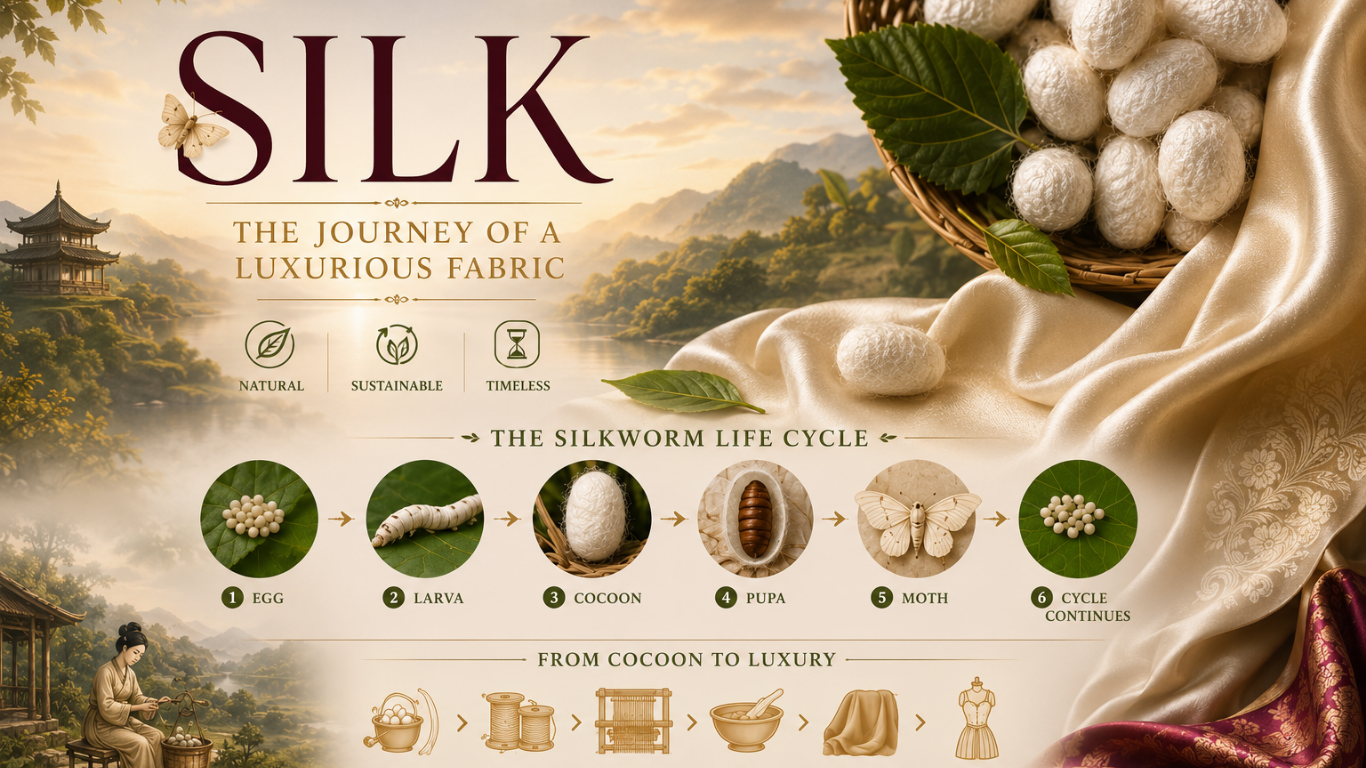
Story of India’s Golden Fibre
SILK: India's Legacy and Nature's Luxury
Silk is a luxurious masterpiece fibre, created by nature and perfected through centuries of craftsmanship. From the shimmering Banarasi sarees of Uttar Pradesh to the elegant Mysore silks of Karnataka, silk has been an integral part of diverse states of India. It deliberates the cultural, economic, and fashion heritage of our country. India is unique because it is the only country in the world that commercially produces all four major varieties of natural silk:
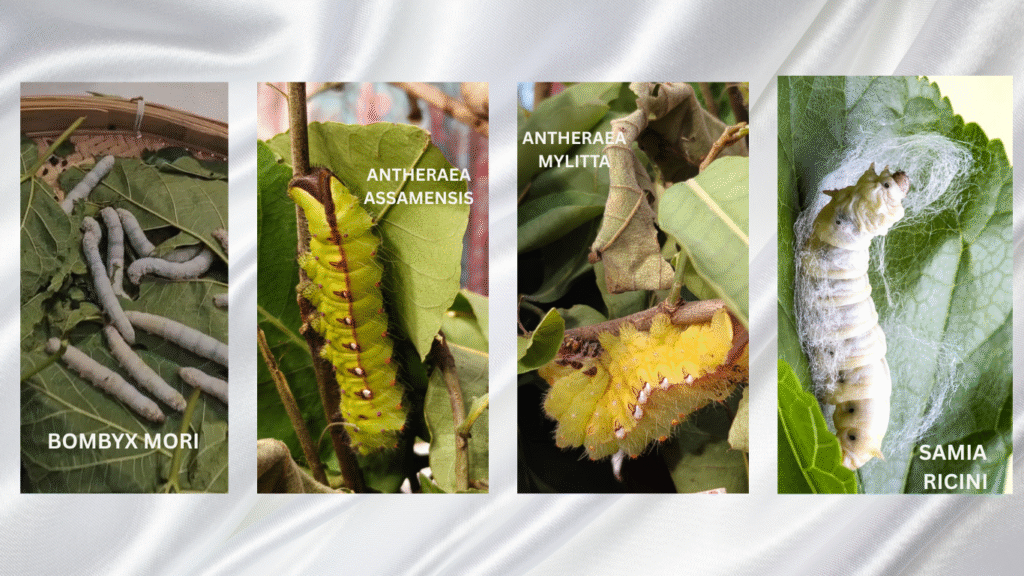
The 4 varieties of silk are obtained from 4 different species of silk moths, found in different parts of India.
- Mulberry Silk: The softest and finest variety of silk (Silkworm: Bombyx Mori) is found majorly in Karnataka.
- Eri Silk: Also known as Ahimsa Silk (Silkworm: Samia Ricini). It is found in north-east India in states like Assam, Meghalaya, Nagaland, Manipur etc.
- Tussar Silk: This is the Raw and wild variety of silk (Silkworm: Antheraea Mylitta), with a flat non-shiny surface. It is found in central and eastern part of India e.g.: Jharkhand, Chhattisgarh, Bihar, Orissa, West Bengal etc.
- Muga Silk: Grown only in Assam (Silkworm: Antheraea Assamensis).
THE ORIGIN OF SILK
Though the Origin of Silk dates back to 2700 BC, in China, widely regarded as the birthplace of silk and cultivation of Silkworm (Sericulture). The story of its origin took place during the reign of the great Yellow Emperor, HUANGDI. His wife Empress LEIZU (also known as Xi Ling Shi), while sitting under a mulberry tree, sipping hot tea. She noticed something dropping from the tree in her teacup. When she tried take it out a long shiny, strong thread-like structure ravelled from an oval ball, THE COCOON. She was deeply intrigued by the beauty and strength of this filament and thereby thought of making something to wear for her husband. That is when she experimented and came up with the process of reeling out silk from the cocoon and making the silkloom.
WHAT EXACTLY IS SILK?
Silk is a natural textile fibre that originates from the saliva of the silkworm, once they start their transformation from a tiny caterpillar like larvae to an adult Silk moth. Silk begins its journey in one of nature’s most remarkable transformations. As a tiny, caterpillar-like silkworm prepares to leave behind its larval life and enter the pupal stage, it begins producing a liquid substance through openings at its mouth tip called spinnerets. This secretion contains two essential proteins: Fibroin, the strong structural protein that forms the core of the silk fibre, and Sericin, the gummy protein that binds and protects it. The moment these liquid proteins meet the air, they begin to solidify into a fine and continuous filament (Usually 9 yards in length). With remarkable precision, the silkworm then winds this filament around its body in a series of looping, figure-eight movements. Layer by layer, an intricate protective cocoon takes shape, enclosing the silkworm within its own handcrafted cocoon as it undergoes its transformation into an adult silk moth. From this delicate act of survival emerges one of the world’s most treasured natural fibre: SILK.
LIFECYCLE OF A SILKWORM
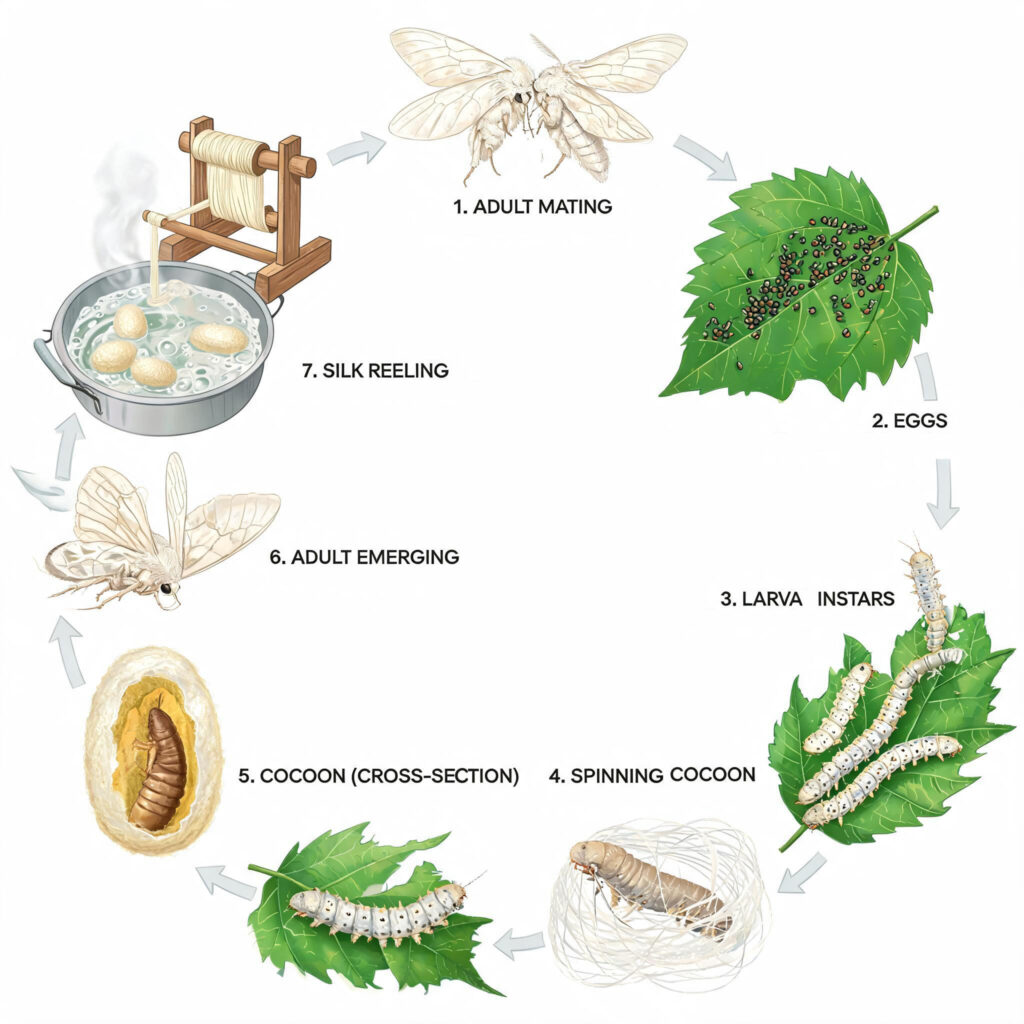
SILK REELING
Silk reeling is the process in which, the silk filament is carefully extracted from the cocoon and converted into usable silk yarn. Each step listed below has a specific purpose: to keep the filament continuous, to clean each filament properly, and to maintain its strength, enough for weaving.
1. Stifling
Stifling is done to kill the pupa inside the cocoon to get full length continuous silk filament from the cocoon. This process is usually done by sun-drying them, steaming the cocoons, or giving them hot air treatment. This step is important for commercial silk production as a damaged cocoon gives shorter, weaker silk.
2. Sorting
After stifling, cocoons are sorted by size, colour, shell thickness, and overall quality. Healthy cocoons with good filament length are sorted out. Damaged, stained, thin, or flossy cocoons are kept separate for other purposes.
3. Boiling or Cooking
The selected cocoons are then boiled in hot water, generally around 95-100°C, so that the water softens the outer gum called sericin. This prepares the cocoon for the next step, finding the end of the filament.
4. Brushing or Deflossing
Brushing removes the loose, damaged outer fibres, from the cocoon surface. These fibres are called floss. This exposes the true reeling end of the filament. Once the end is exposed using a soft light brush, reeling can begin smoothly.
5. Reeling
Reeling is the true unwinding of the silk filament from the cocoon. Since one filament is too fine and weak by itself, several filaments, often 5 to 10, are combined together and twisted into a single strong yarn. Once the filaments are reeled out, they are wound onto reels or bobbins to form raw silk.
6. Drying and Twisting
After reeling, the silk is dried to remove excess moisture. It may also be twisted further to improve strength, stability, and handling quality. This makes the yarn more suitable for weaving and later textile processing. The drying and twisting stage helps the silk keep its shape and reduces breakage during use.
7. Raw Silk Ready for Weaving
The final product at this stage is raw silk yarn, which can then be woven into fabric. This raw silk may later undergo additional processing such as scrooping, degumming, bleaching, dyeing, or finishing depending on the final textile product.
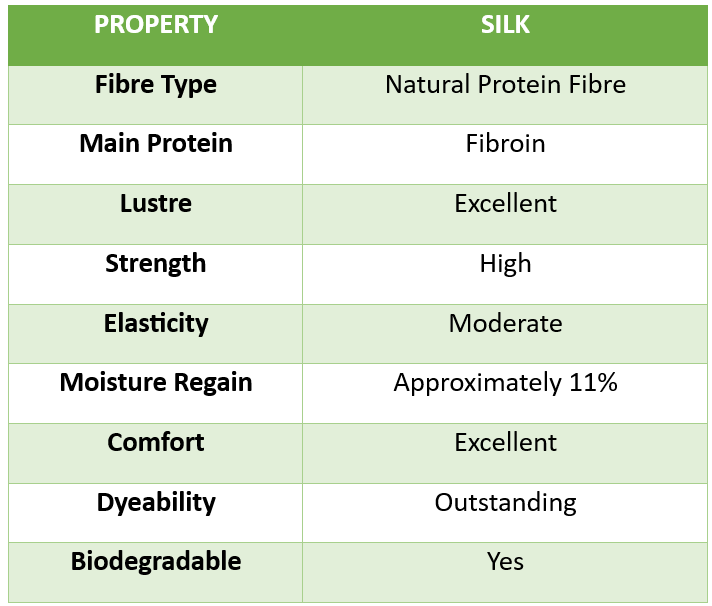
SILK INDUSTRY, PROPERTIES & SUSTAINABILITY
India is the second-largest producer of silk in the world and supports millions of rural families through sericulture. The industry is particularly significant because it combines agriculture, animal husbandry, cottage industries, and textile manufacturing.
Modern fashion increasingly values sustainability, and silk plays an important role when produced responsibly. Ethical practices include:
- Organic sericulture
- Natural dyeing
- Eri (Peace) Silk production
- Water-efficient processing
- Waste utilization (silk noil and spun silk)
Designers are blending silk with fibres like linen, bamboo, hemp, and organic cotton to create eco-conscious luxury textiles.
Silk represents a remarkable fusion of biology, tradition, craftsmanship, and innovation. India’s ability to produce all four major natural silk varieties makes it a global leader in sericulture and an invaluable source of inspiration for fashion and textile professionals.
Mastering silk is not just about appreciating its beauty—it is about understanding the science, engineering, and craftsmanship that transform a delicate cocoon into one of the world’s most celebrated textiles.
Whether you aspire to become a fashion designer, textile technologist, researcher, or entrepreneur, understanding silk is fundamental to appreciating the artistry and science behind one of nature’s most extraordinary fibres.
Exploring fashion, textiles, design innovation, and material science from a 360° perspective.