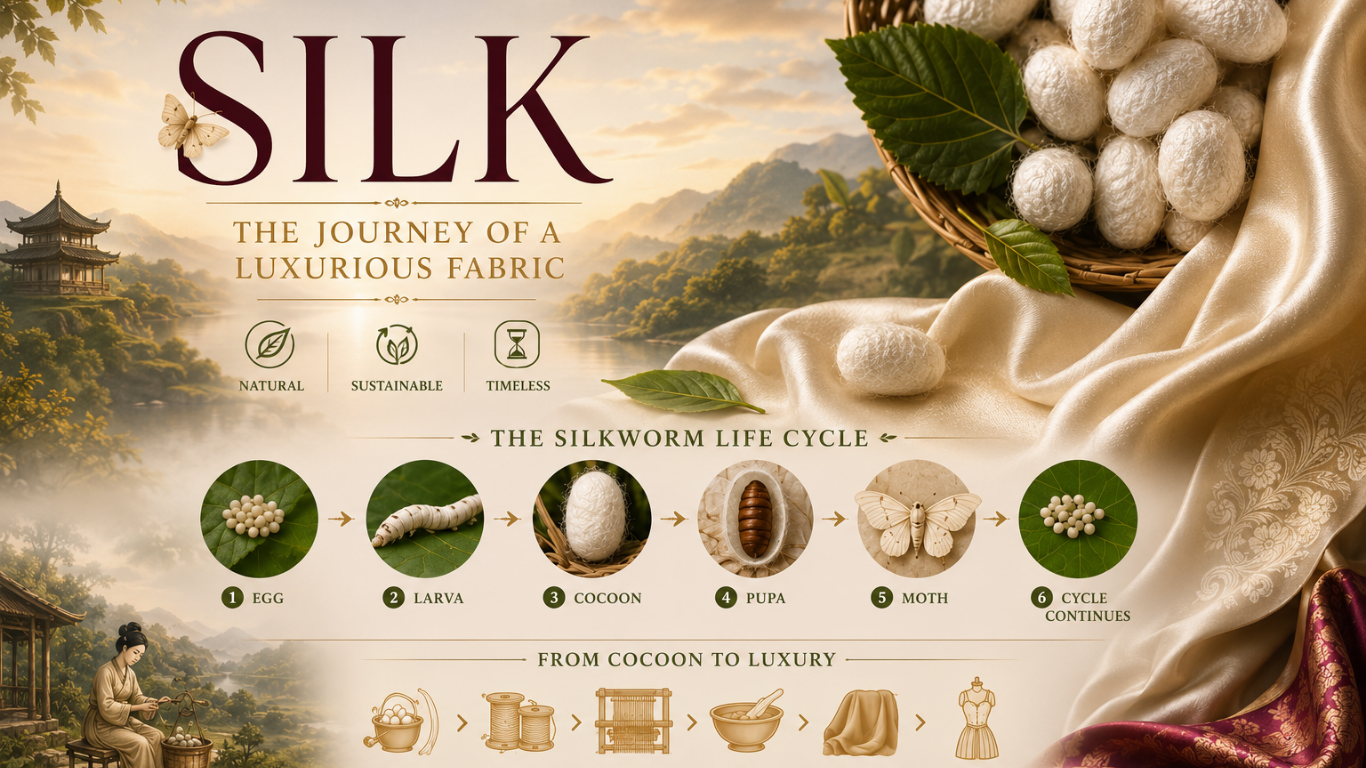
Silk in India: From Cocoon to Couture

SILK THE JOURNEY OF A LUXURIOUS FABRIC FROM COCOON TO COUTURE

Story of India’s Golden Fibre

SILK: India's Legacy and Nature's Luxury

Silk is a luxurious masterpiece fibre, created by nature and perfected through centuries of craftsmanship. From the shimmering Banarasi sarees of Uttar Pradesh to the elegant Mysore silks of Karnataka, silk has been an integral part of diverse states of India. It deliberates the cultural, economic, and fashion heritage of our country. India is unique because it is the only country in the world that commercially produces all four major varieties of natural silk:

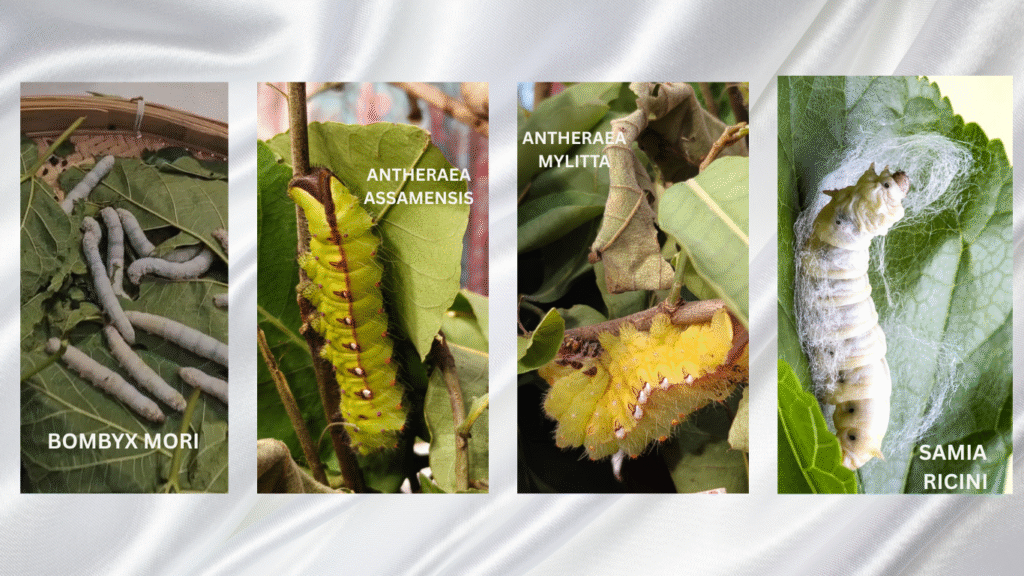
The 4 varieties of silk are obtained from 4 different species of silk moths, found in different parts of India.

  1. Mulberry Silk: The softest and finest variety of silk (Silkworm: Bombyx Mori) is found majorly in Karnataka.
  2. Eri Silk: Also known as Ahimsa Silk (Silkworm: Samia Ricini). It is found in north-east India in states like Assam, Meghalaya, Nagaland, Manipur etc.
  3. Tussar Silk: This is the Raw and wild variety of silk (Silkworm: Antheraea Mylitta), with a flat non-shiny surface. It is found in central and eastern part of India e.g.: Jharkhand, Chhattisgarh, Bihar, Orissa, West Bengal etc.
  4. Muga Silk: Grown only in Assam (Silkworm: Antheraea Assamensis).
THE ORIGIN OF SILK

Though the Origin of Silk dates back to 2700 BC, in China, widely regarded as the birthplace of silk and cultivation of Silkworm (Sericulture). The story of its origin took place during the reign of the great Yellow Emperor, HUANGDI. His wife Empress LEIZU (also known as Xi Ling Shi), while sitting under a mulberry tree, sipping hot tea. She noticed something dropping from the tree in her teacup. When she tried take it out a long shiny, strong thread-like structure ravelled from an oval ball, THE COCOON. She was deeply intrigued by the beauty and strength of this filament and thereby thought of making something to wear for her husband. That is when she experimented and came up with the process of reeling out silk from the cocoon and making the silkloom.


WHAT EXACTLY IS SILK?

Silk is a natural textile fibre that originates from the saliva of the silkworm, once they start their transformation from a tiny caterpillar like larvae to an adult Silk moth. Silk begins its journey in one of nature’s most remarkable transformations. As a tiny, caterpillar-like silkworm prepares to leave behind its larval life and enter the pupal stage, it begins producing a liquid substance through openings at its mouth tip called spinnerets. This secretion contains two essential proteins: Fibroin, the strong structural protein that forms the core of the silk fibre, and Sericin, the gummy protein that binds and protects it. The moment these liquid proteins meet the air, they begin to solidify into a fine and continuous filament (Usually 9 yards in length). With remarkable precision, the silkworm then winds this filament around its body in a series of looping, figure-eight movements. Layer by layer, an intricate protective cocoon takes shape, enclosing the silkworm within its own handcrafted cocoon as it undergoes its transformation into an adult silk moth. From this delicate act of survival emerges one of the world’s most treasured natural fibre: SILK.

LIFECYCLE OF A SILKWORM
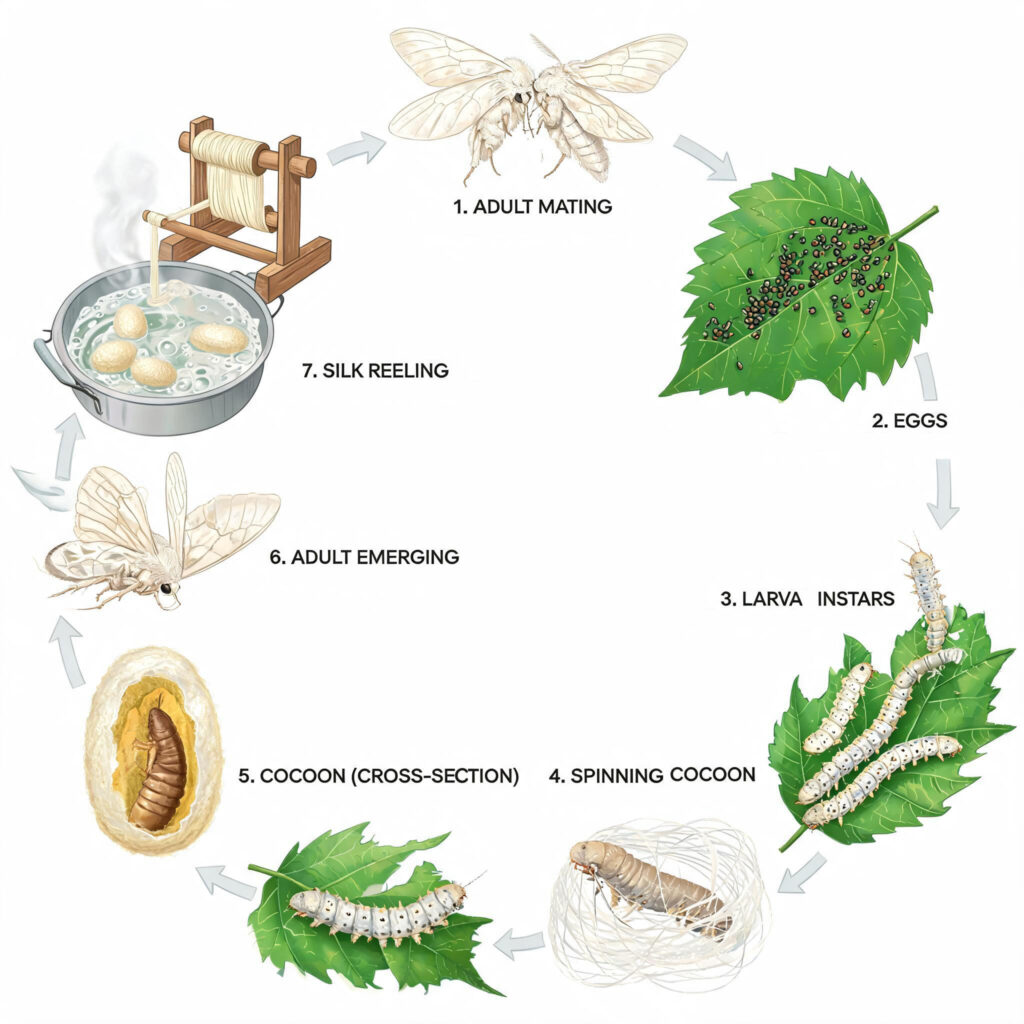
An adult silk moth lays nearly 300-500 eggs once in their lifetime. They are the size of a pinhead/poppy seeds and change their colour as the time goes by. they hatch into a larva (3-5mm) in a span of 10-12 days.

They feed exclusively on the tree leaves they live on and go through almost five growth stages called instars over nearly 25-30 days. The last instar larva stops eating as it prepares to spin its cocoon.

The mature larva secretes a continuous silk filament (approx. 9 yards long) from its salivary glands through spinnerets, moving in figure-eight patterns for 3-5 days to form a protective cocoon. The cocoon is oval-shaped, white, cream or golden beige coloured, with a hard outer layer and soft inner layers.

Inside the cocoon, the larva transforms into a pupa over 12-18 days. The pupa is brown, hard-shelled, and undergoes complete metamorphosis into the adult moth. In commercial silk production, cocoons are typically harvested at this stage.

If allowed to complete development, the pupa secretes an alkaline fluid to soften one end of the cocoon and emerges as an adult moth. The moth cannot fly and lives only 5-10 days to mate and lay eggs, completing the lifecycle.

SILK REELING

Silk reeling is the process in which, the silk filament is carefully extracted from the cocoon and converted into usable silk yarn. Each step listed below has a specific purpose: to keep the filament continuous, to clean each filament properly, and to maintain its strength, enough for weaving.

1. Stifling

Stifling is done to kill the pupa inside the cocoon to get full length continuous silk filament from the cocoon. This process is usually done by sun-drying them, steaming the cocoons, or giving them hot air treatment. This step is important for commercial silk production as a damaged cocoon gives shorter, weaker silk.

2. Sorting

After stifling, cocoons are sorted by size, colour, shell thickness, and overall quality. Healthy cocoons with good filament length are sorted out. Damaged, stained, thin, or flossy cocoons are kept separate for other purposes.

3. Boiling or Cooking

The selected cocoons are then boiled in hot water, generally around 95-100°C, so that the water softens the outer gum called sericin. This prepares the cocoon for the next step, finding the end of the filament.

4. Brushing or Deflossing

Brushing removes the loose, damaged outer fibres, from the cocoon surface. These fibres are called floss. This exposes the true reeling end of the filament. Once the end is exposed using a soft light brush, reeling can begin smoothly.

5. Reeling

Reeling is the true unwinding of the silk filament from the cocoon. Since one filament is too fine and weak by itself, several filaments, often 5 to 10, are combined together and twisted into a single strong yarn. Once the filaments are reeled out, they are wound onto reels or bobbins to form raw silk.

6. Drying and Twisting

After reeling, the silk is dried to remove excess moisture. It may also be twisted further to improve strength, stability, and handling quality. This makes the yarn more suitable for weaving and later textile processing. The drying and twisting stage helps the silk keep its shape and reduces breakage during use.

7. Raw Silk Ready for Weaving

The final product at this stage is raw silk yarn, which can then be woven into fabric. This raw silk may later undergo additional processing such as scrooping, degumming, bleaching, dyeing, or finishing depending on the final textile product.


SILK INDUSTRY, PROPERTIES & SUSTAINABILITY

India is the second-largest producer of silk in the world and supports millions of rural families through sericulture. The industry is particularly significant because it combines agriculture, animal husbandry, cottage industries, and textile manufacturing.

Modern fashion increasingly values sustainability, and silk plays an important role when produced responsibly. Ethical practices include:

  • Organic sericulture
  • Natural dyeing
  • Eri (Peace) Silk production
  • Water-efficient processing
  • Waste utilization (silk noil and spun silk)

Designers are blending silk with fibres like linen, bamboo, hemp, and organic cotton to create eco-conscious luxury textiles.
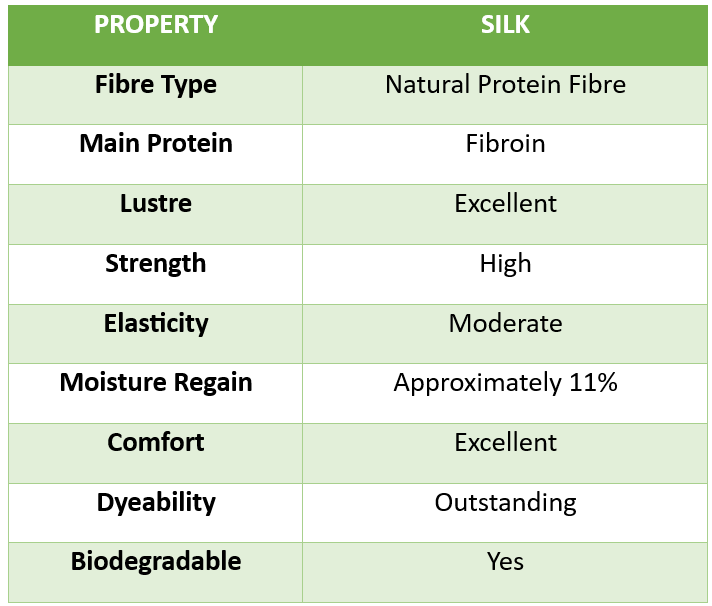
Silk represents a remarkable fusion of biology, tradition, craftsmanship, and innovation. India’s ability to produce all four major natural silk varieties makes it a global leader in sericulture and an invaluable source of inspiration for fashion and textile professionals.

Mastering silk is not just about appreciating its beauty—it is about understanding the science, engineering, and craftsmanship that transform a delicate cocoon into one of the world’s most celebrated textiles.

Whether you aspire to become a fashion designer, textile technologist, researcher, or entrepreneur, understanding silk is fundamental to appreciating the artistry and science behind one of nature’s most extraordinary fibres.

Exploring fashion, textiles, design innovation, and material science from a 360° perspective.

Choose the Right Fabric for Every Garment Type

Choosing the right fabric/textile material bring a sketched design to life. It is the basic thing a designer must initially analyse. the correct textile material defines a garment/apparel’s drape, comfort, suitability, durability, ability to incorporate elements like patchwork, embroidery etc. Apart from this, it also helps us analyse its aftercare and launderability (washability). the correct choice of fabric also helps in understanding the season in which a garment can be worn. From the first pencil stroke on a sketchpad to the final stitch on a runway-ready piece, fabric is the soul of fashion.

As per the author's experience in teaching, evaluation of budding designers and interactions with other designer's world over, it was observed that the designers usually design a garment but are unable to select the perfect fabric to execute their collection. This turns into a huge disaster most of the times and even leads to downfall of their brands/couture house.
So, as a designer it is a must to know the basic knowhow of fabrics first and then land up designing a garment or a collection.

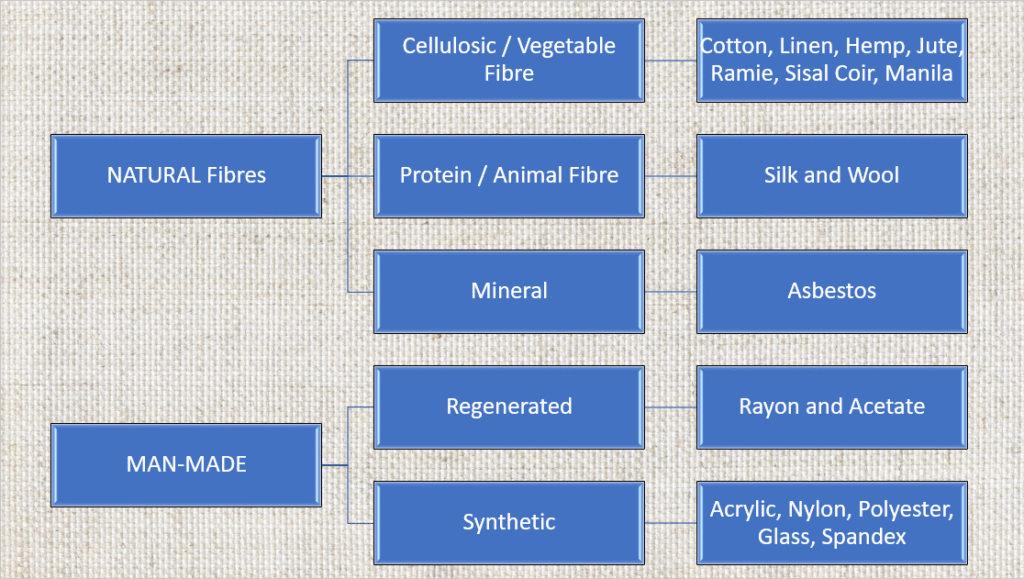
Going ahead and understanding the basic knowhows of a textile material, fabric is a sheet of fibres combined together by interloping, interlacing or bonding the fibres together. A fabric’s basic raw material is a fibre. Fibres used in manufacturing of textile fabrics, are either Natural in origin, or Manmade, or they can also be a combination of both natural and manmade fibres called Regenerated Fibres. Let’s dig a little deeper to understand how we decide on what kind of fabric to choose for what type of garment.

Natural Fibres are the ones, that we obtain from nature. Nature implies plants, animals and minerals.

  1. Plant fibres are obtained from stem, leaves, bark, fruit etc.
  2. Animal fibres are obtained from skin, hair, or secretions by the animals
  3. Mineral fibres are obtained from mineral deposits in the earth

The fibres available in the market from any of these sources are tested for their strength, pliability, durability, flexibility, texture, absorbency or moisture retention before being made or constructed into a fabric. they should have ample of strength, durability, pliability and flexibility to be made into a fashion garment/apparel. the texture should be such that it shouldn’t harm the skin, rather protect it from external factors like, cold, heat, wind, snow, ice, rain, dust etc. For comfort and climatic conditions, it should have the ability to absorb moisture. When we perspire/sweat, the sweat needs to be absorbed well by the fabric, to prevent any skin infection or allergenic reactions.

Qualities of Natural Fibres
  1. Natural fibers in general are hypoallergenic, extremely good for the skin and have high water absorbency.
  2. All cellulosic natural fibers can be given a tumble wash, until any dye or print is applied to it. these fibres gain almost double the strength in wet conditions, hence in day-to-day life, you may have observed that washing and wringing of cotton, linen etc. (the summer wear fabric) never destroys or damages the fabric.
  3. All Protein fabrics need to be dry cleaned as tumble wash or washing and wringing reduces their strength, makes the weak and prone to damages very quickly. They are wonderful fabrics for winterwear as their natural property is to trap and hold the body heat.

Man made fibres on the other hand are of two types:

  1. Regenerated: The ones which are made by mixing a natural fiber with a chemical in which it dissolves and is then made into a fabric eg Rayon and Acetate
  2. Synthetic fibres: The ones that are made by combining two or more different chemicals and then made into a fabric eg: Acrylic, Nylon, Polyester, Glass, Spandex/Lycra

These are called man-made fibres as they are manufactured in chemical laboratories or plants by mixing chemical compound that on cooling, solidify into fibres or yarns and are eventually made into fabrics.

Qualities of Man- Made Fibres
  1. All man-made fibres get weak when wet.
  2. All regenerated fibres like Rayon, Viscose, Tencel, Lyocell etc. absorb moisture, but less than the natural fibers and are mostly suitable for summer wear, during rainy season or in pleasant weather conditions. It is advised not to use them as undergarments or as lingerie wear as they can cause allergies or skin irritation.
  3. All synthetic fibers like Polyester, Nylon, Spandex etc. are hydrophobic and do not absorb much water. they are therefore used for making swimwear, fishing nets, winter wear jackets, as paddings for quilted garments, winter quilts etc.

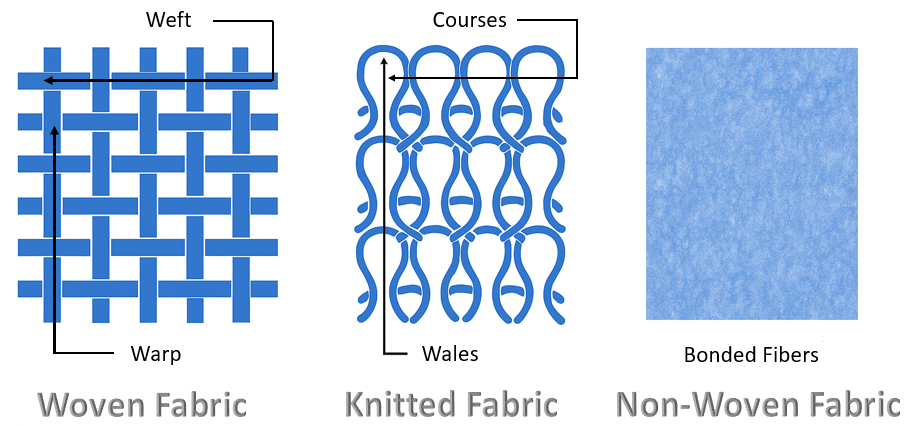
The fibres obtained from above sources, are made into yarns, the long strands of fibres combined together by the process of spinning. These yarns can be made thick or thin depending on the fabric to be constructed. For example, georgette needs a thin yarn for construction whereas denim needs a thick yarn. The thickness or thinness of a yarn determines the weight of a fabric called GSM (Gram per square meter). Higher the GSM, heavier the fabric, lesser the GSM, lighter the fabric. Another factor is the thread count of a fabric.  To understand the basics of thread count, it’s important to know the types of fabric and how each one is made. There are 3 ways to construct fabrics – interlacing, interloping and bonding the fibres together.

  • WOVEN FABRICS: Made by interlacing two sets of yarns, the lengthwise ones known as WARP and width wise, WEFT yarns at an angle of 90 degrees
  • KNITTED FABRICS: Made by interloping minimum one set of yarn. It has loops running in lengthwise direction, known as WALES and other in width wise direction, known as COURSES.
  • NON-WOVEN FABRICS: Made by bonding or entangling fibres with one another.

THREAD COUNT

Thread count can be calculated for woven fabrics by evaluating the number of yarns per square inch of a woven fabric. It is calculated by summing up the number of warp and weft yarns per inch of a woven fabric of any type or origin. For example, in a fabric if there are 133 warp yarns and 100 weft yarns, the thread count of that fabric will be 133+100 = 233TC.

The fabrics can be made using any fibres, may they be natural or manmade. Thread counts are mostly mentioned on the, commercially on home furnishing fabrics like bedsheets, table covers, table mats, throws etc., but they are essential even while selecting fabrics for designing garments. While going out purchasing fabrics one can enquire for the thread count to match with their designed collection.

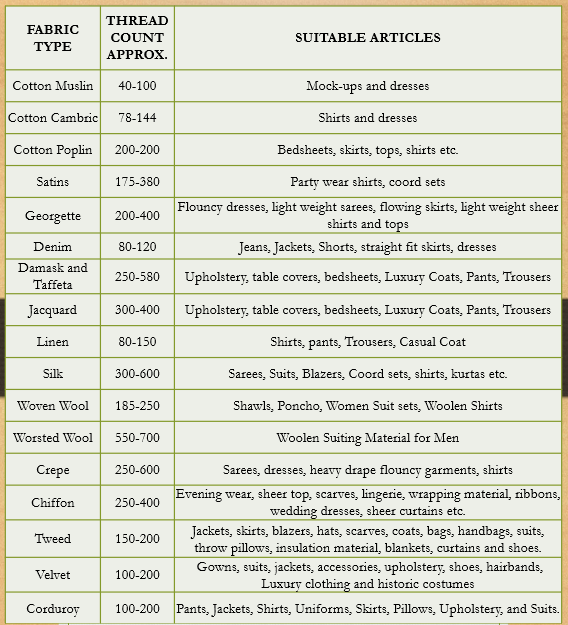
Mentioned here are some of the majorly used fabrics and their approximate average Thread count, available commercially

But it must be noted that it is not the only parameter that determines the quality of a fabric. The other factors are

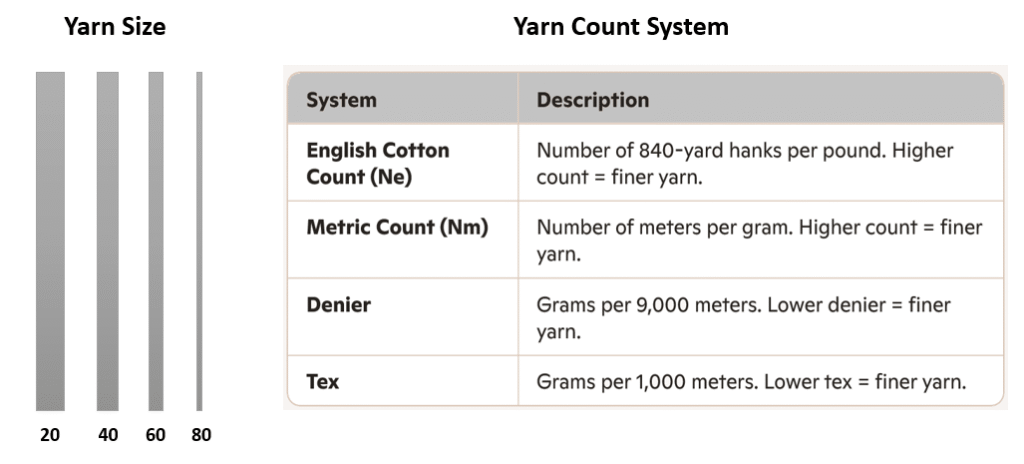
  • YARN SIZE – It determines the weight of a fabric, higher the yarn size, lighter the fabric. It is measured in two systems, namely Yarn Count System (It measures the length per unit weight of yarn) and Yarn Weight Category. The yarn count system is majorly used by fashion and textile industry and is measured in the unit Ne. So, a 50 Ne cotton yarn is finer than a 10 Ne yarn.
  • YARN QUALITY – It determines the longevity of the fabric. The better the origin, the longer will be the life of a fabric.
  • WEAVE – The more compact the weave, higher will be the thread count, more will be the strength and tougher will be the drape of the fabric.

Want to know more about Weaving, Knitting, Non-Wovens, Fabrics, Yarns or Fibres? Comment below

RSS
Follow by Email
Instagram
Telegram
WhatsApp