Pantone Color of the Year 2026

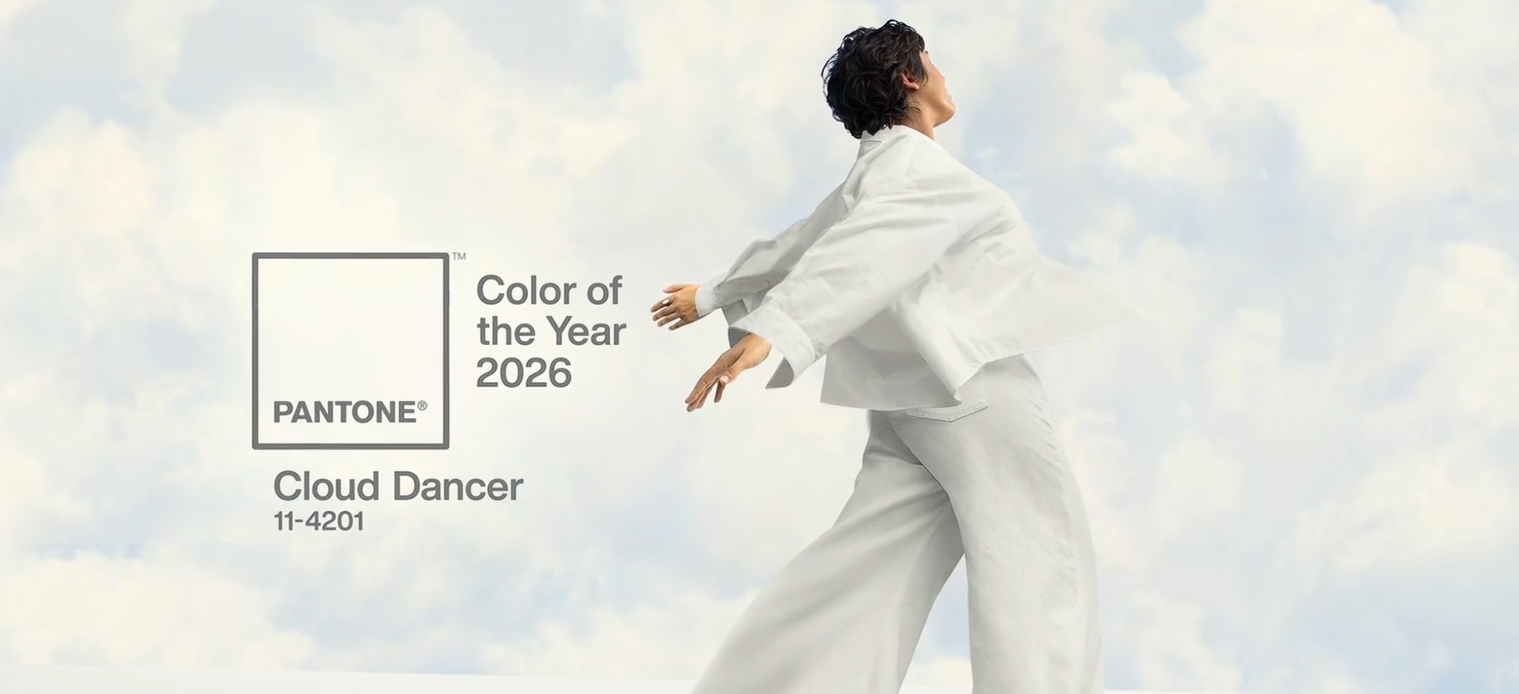
This new year 2026, the runway will be swaying in the newly revealed ‘COLOR OF THE YEAR’ – CLOUD DANCER (Pantone11-4201).  In a world, where color has become synonymous with personal expression, this is a shade that can adapt, harmonize, and create contrast, bringing a feeling of airy lightness to all product applications and environments, whether making a standalone statement or combined with other hues.

It’s a Lofty white neutral color, whose aerated presence acts as a whisper of calm and peace in a noisy world. This pantone shade cloud dancer symbolises calming influence in the society, discovering the value of quiet reflection. A Billowing white imbued with serenity, invites true Relaxation and focus, allowing the mind to wander and creativity to breathe. In motion and in pause, this Pantone shade Cloud Dancer, drifts between light and ethereal, a living calm that invites renewal, vision in serenity and creative release

“At this time of transformation, when we are reimagining our future and our place in the world, PANTONE 11-4201 Cloud Dancer is a discrete white hue offering a promise of clarity. The cacophony that surrounds us has become overwhelming, making it harder to hear the voices of our inner selves. A conscious statement of simplification, Cloud Dancer enhances our focus, providing release from the distraction of external influences.”

Leatrice Eiseman
Executive Director, Pantone Color Institute


ABOUT PANTONE

PANTONE recognized globally as a leading source of color expertise, Pantone Color Institute provides color insights and solutions; collaborating with their clients to strategically address color challenges and develop a color and design approach, consistent with their brand vision. Visualising what is mostly being liked by the masses and their own research teamwork, this is for the first time that this hue of white has been announced as the color of the year.

Pantone provides a universal language of color that enables color-critical decisions through every stage of the workflow for the brands and the manufacturers. More than 10 million designers from the field of fashion, interior, graphic design, product design etc. and producers around the world rely on Pantone products to help define, communicate and control color from inspiration to realization – leveraging advanced X-Rite technology to achieve color consistency across various materials and finishes.

Pantone Standards feature digital and physical color specification and workflow tools. The Pantone Color Institute provides customized color standards, brand identity and product color consulting as well as trend forecasting inclusive of Pantone Color of the Year, Fashion Runway Color Trend Reports, color psychology and more.

Source: Pantone


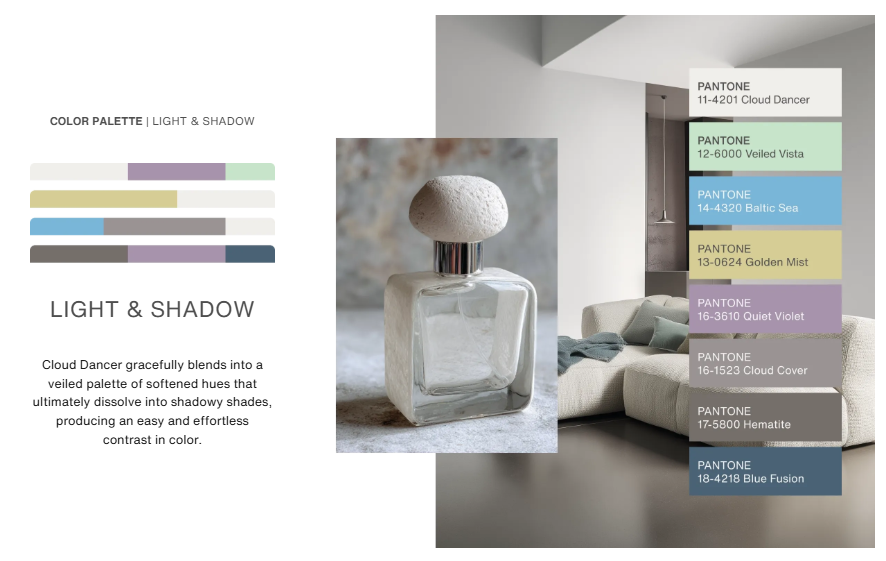
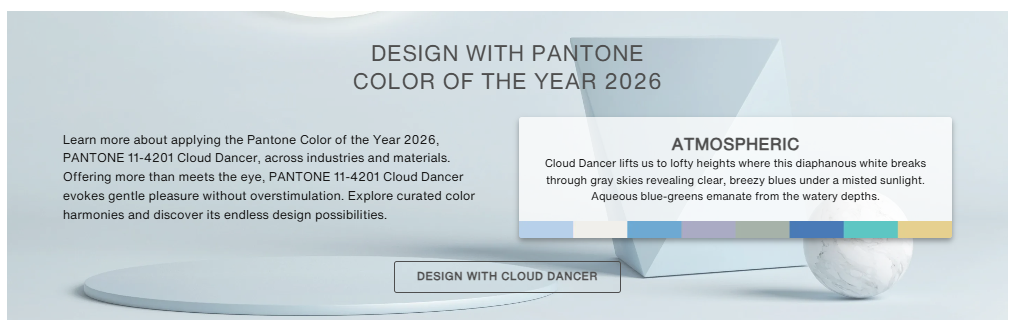
THE COLOR PALETTES
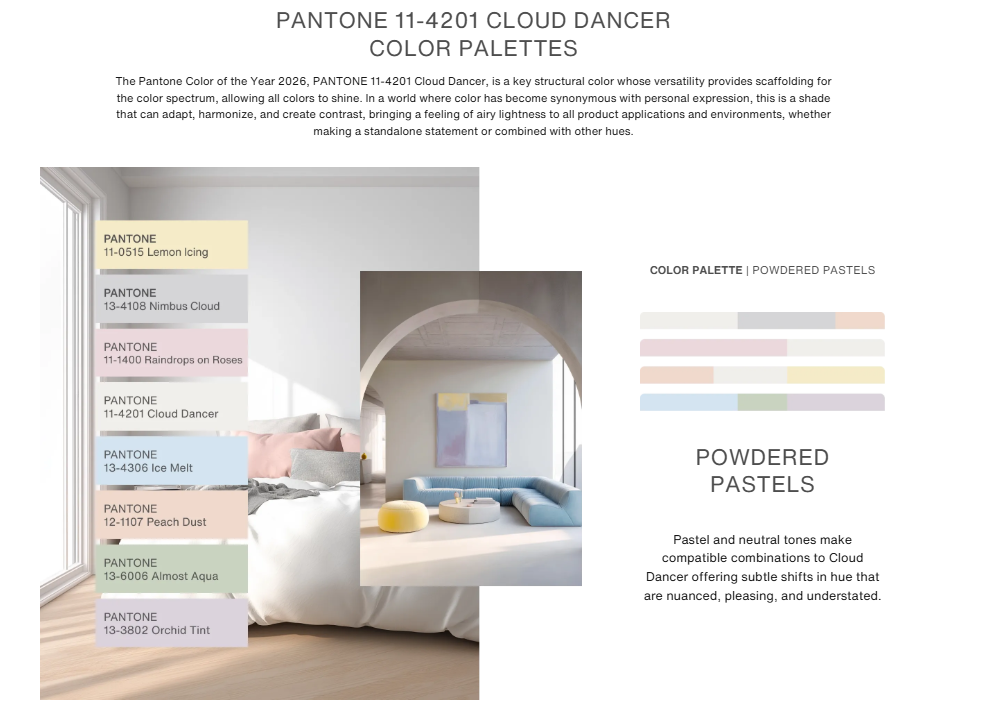
Source: Pantone Website


PANTONE CLOUD DANCER COLABORATIONS

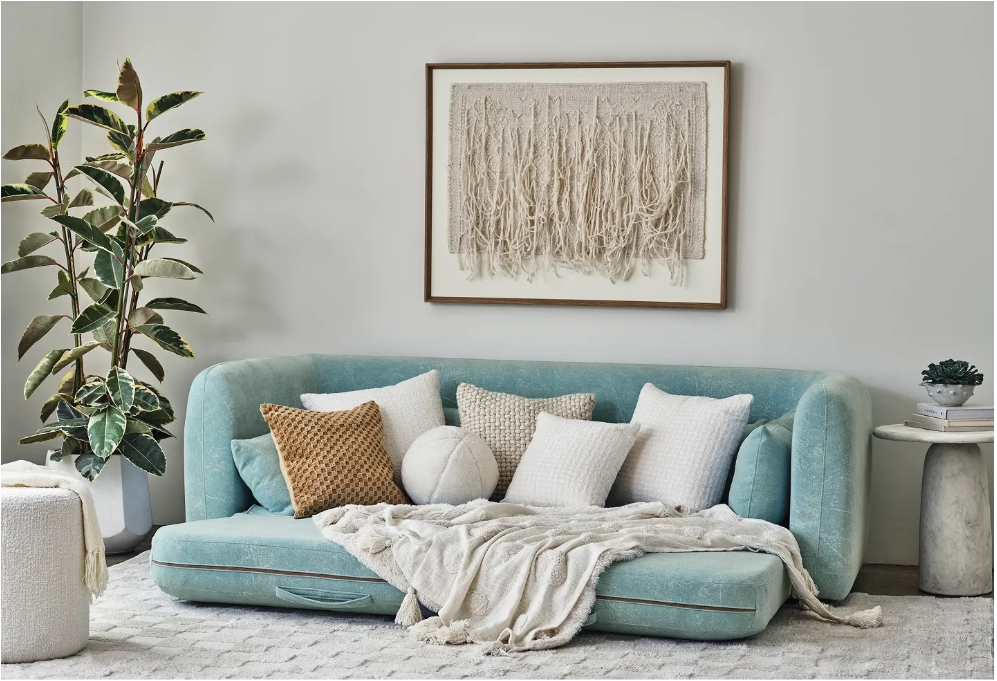
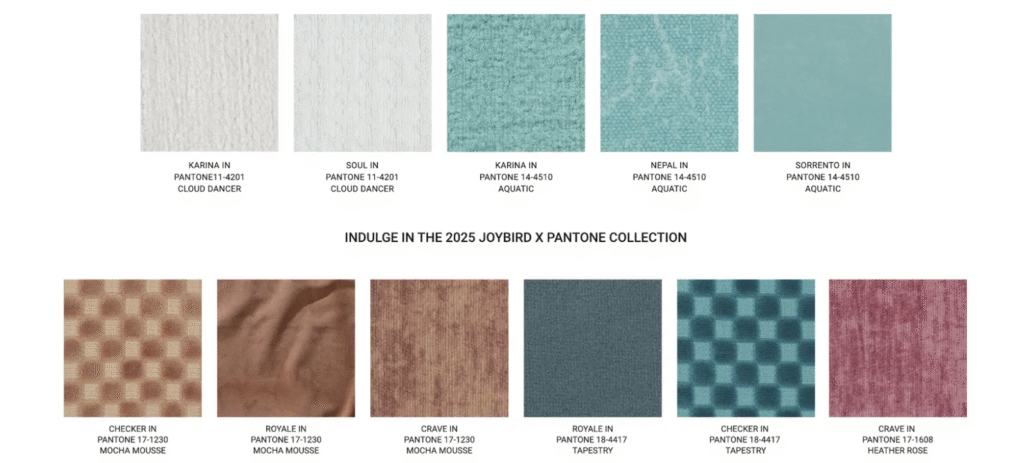
Cultivating calm and relaxation, Joybird is an interior design brand spread across the world that combines aesthetics to interior, and blends textures and visual appeal amongst its clients. The exclusive Joybird x Pantone collaboration fulfills our longing for harmony at home with invitingly tactile fabrics that evoke serenity and inspire quiet reflection.
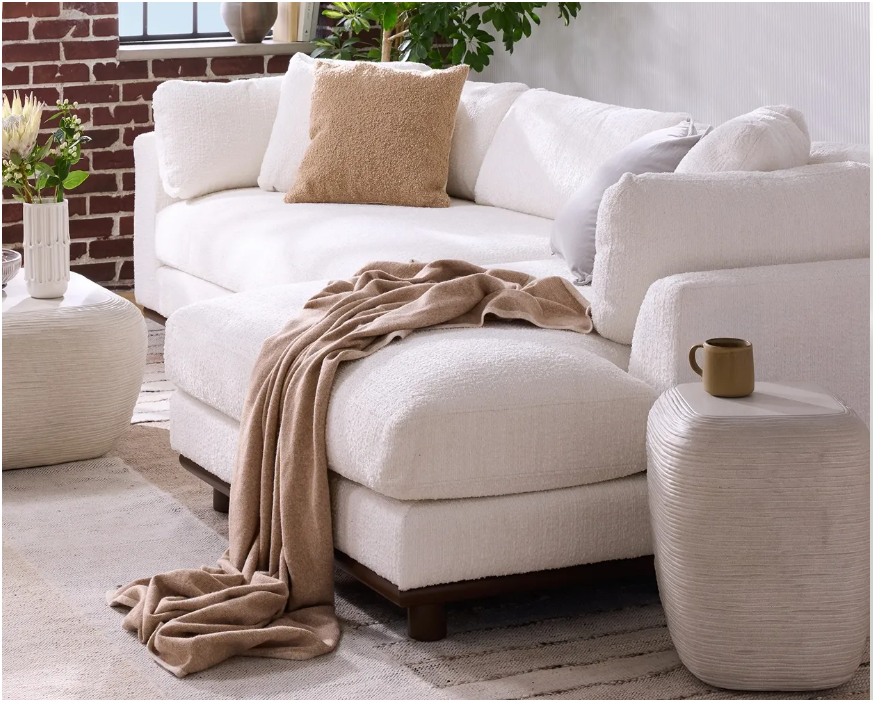
SOURCE: Joybird x Pantone Collaboration is here


Mandarin Oriental x Pantone is transforming into a place to touch the clouds with 10 unique interpretations of the campaign in its exceptional properties around the world. Discover a place to touch the clouds, where only at Mandarin Oriental can you see, feel, taste, and touch the Pantone Color of the Year 2026, PANTONE 11-4201 Cloud Dancer. From curated Cloud Dancer afternoon tea sets and oxygenating spa treatments to luxurious stays high up in the clouds and Cloud Dancer post boxes for letters to Santa, there’s truly something for everyone.
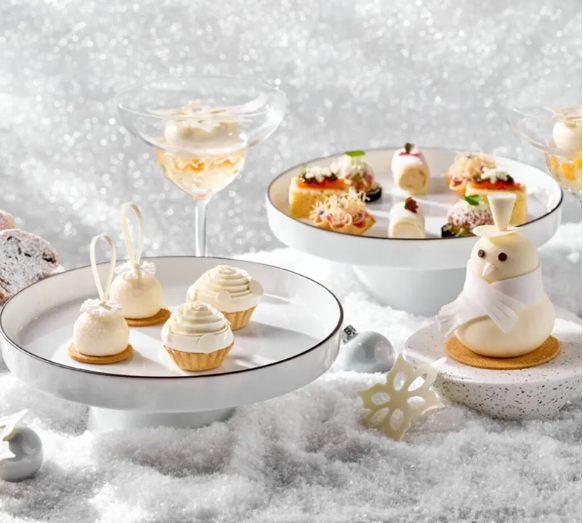
SOURCE: Mandrin Oriental


The Pantone Color of the Year partnership continues this legacy, introducing a hue that embodies the limitless creative possibilities of a blank canvas where every great idea comes to life. Celebrating 70 years of imagination with Play-Doh x Pantone Color of the Year 2026, PANTONE 11-4201 Cloud Dancer. A serene white that invites calm, creativity, and connection, because sometimes the best play starts with a blank canvas.
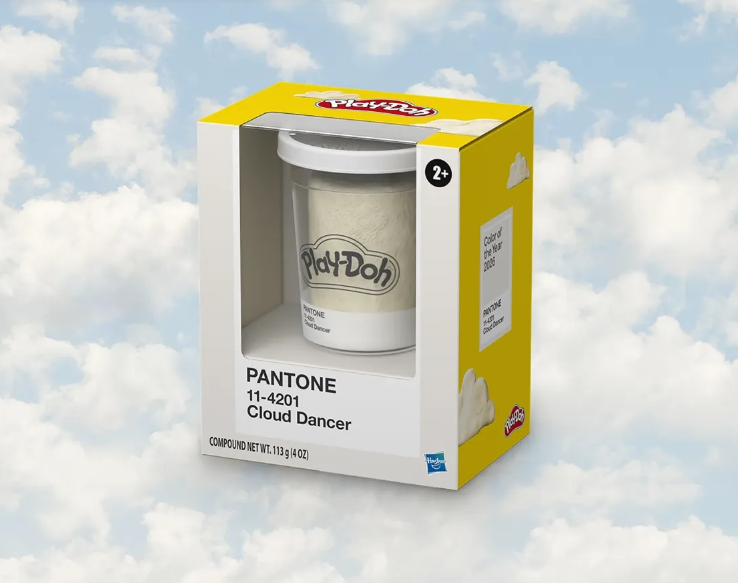
SOURCE: Play-Doh


When Pantone’s mastery of colour meets Motorola’s iconic design legacy, technology becomes an artistic innovation. Together, we’re redefining what it means to connect through devices that express individuality, inspire creativity, and celebrate the beauty of human connection.


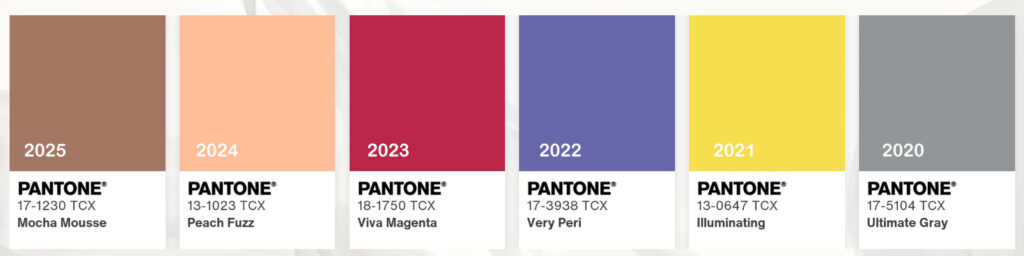
PANTONE SHADES OF PAST 5 YEARS
"Similar to a blank canvas, Cloud Dancer signifies our desire for a fresh start. Peeling away layers of outmoded thinking, we open the door to new approaches. An airy white hue, PANTONE 11-4201 Cloud Dancer opens up space for creativity, allowing our imagination to drift so that new insights and bold ideas can emerge and take shape."

Laurie Pressman
Vice President, Pantone Color Institute
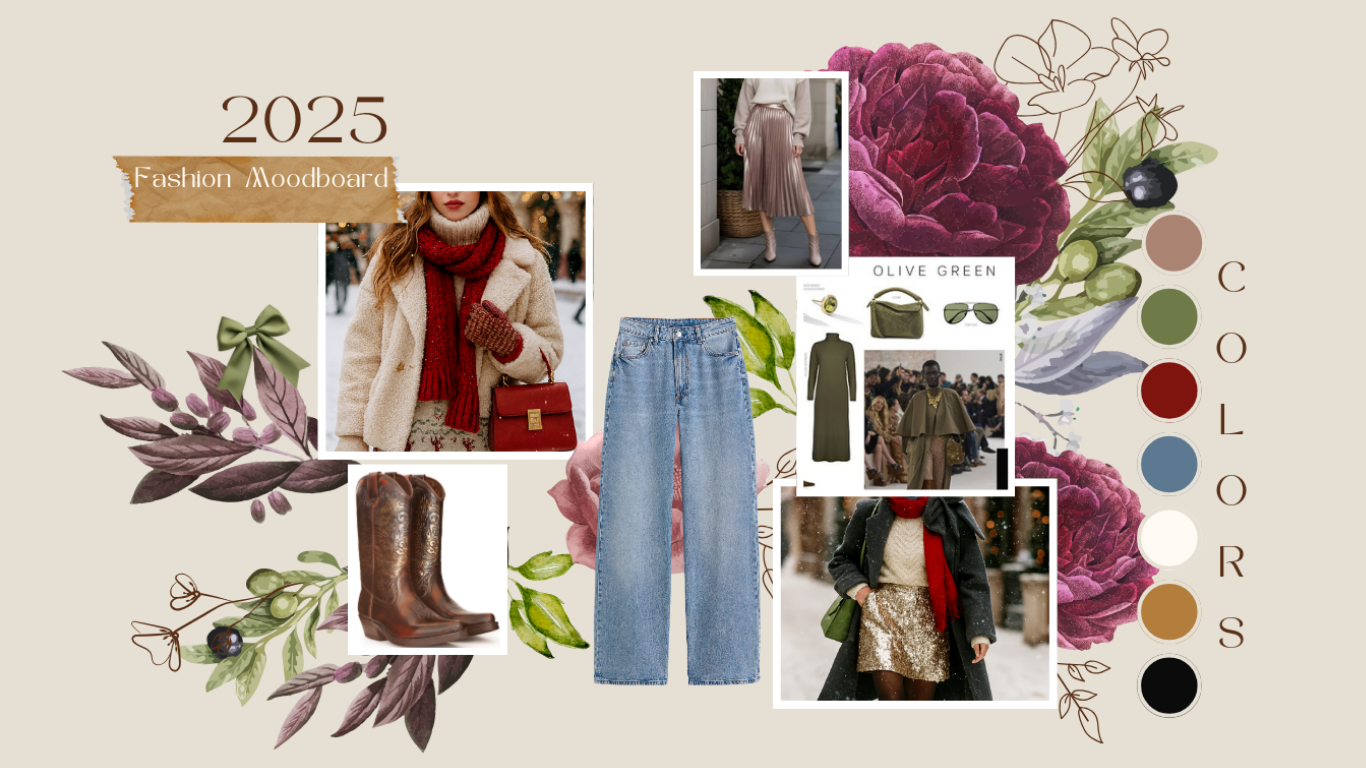
Winter Fashion Trends 2025

Winter 2025 has arrived with a new set of trends to set the vibes of 2025-26. It is the season that combines bold fashion statement, combined with dramatic oversized silhouettes combining ease and comfort with bold and elusive style.

This season embarks a statement with oversized relaxed baggy silhouettes, statement looks, playful layering’s and textures, fabric mixing, bold animal prints and striking accessories to stay fashionable yet cosy throughout the chilly winter months.

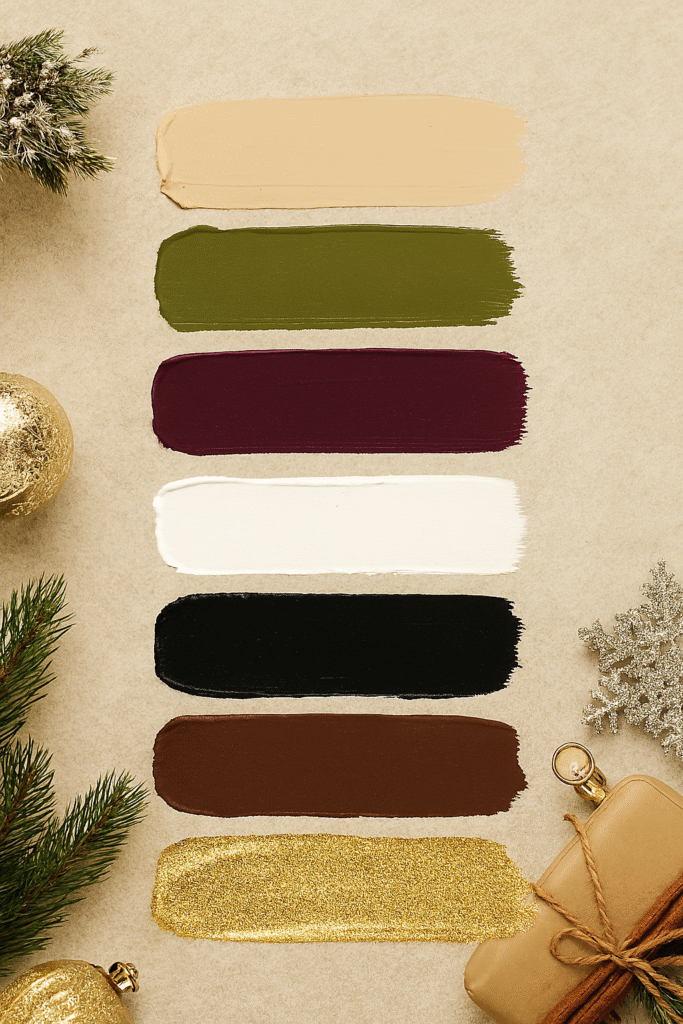
With Christmas arriving this winter, the buzz is all about redefining cozy elegance with relaxed fits, festive sparks by the use of colors like Olive Green, blues and violets, beige, white and maroons accompanied by all neutral colors, like grey, black and brown, and their shades and tints. what is trending this season is a subtle sparkle and shimmer and revival of a much casual yet cool silhouettes along with luxurious fabrics like Velvet, corduroy and flannel. Think oversized knits, shimmering textures, and accessories that feel like heirlooms.

KEY WINTER & CHRISTMAS FASHION TRENDS 2025
  • Color Palette
  • Fabrics and Textures
  • Prints and Patterns
  • Garment Silhouette
  • Fashion Accessories

COLOR PALETTE

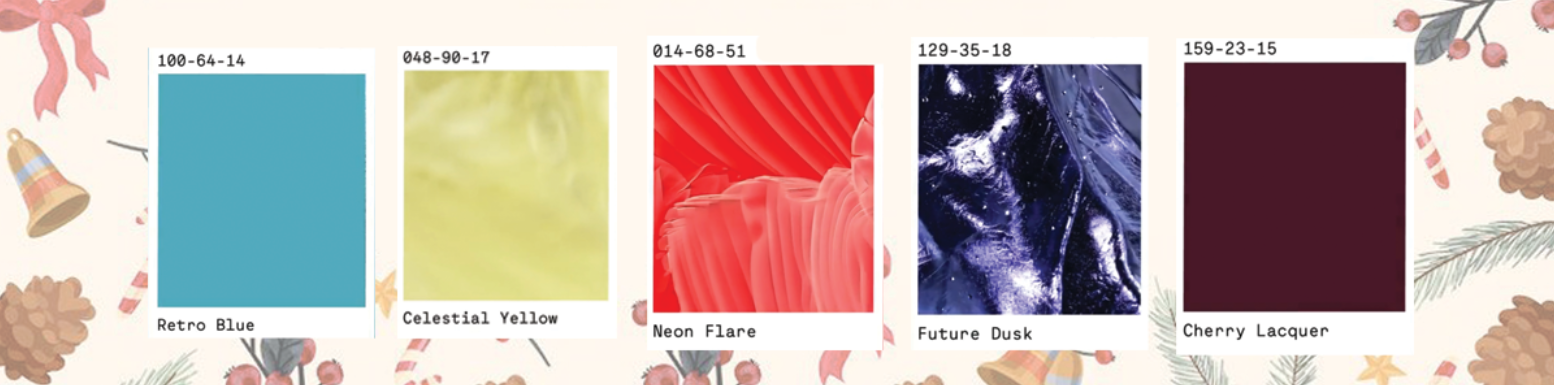
Winters are naturally accompanied by days falling shorter and nights growing longer. This brings change in the fashion color trends. This winter be ready to embrace a much bolder and more vivacious color palette.

  • Retro Blue (Pantone)
  • Celestial yellow and Olive Green (Pantone)
  • Cherry Lacquer and Neon flare (Pantone)
  • Future Dusk (Pantone)
  • Black (Fashion)
  • Whites and off Whites (Fashion)
  • Mocha Mousse (Pantone) / shades of brown

FABRICS AND TEXTURES

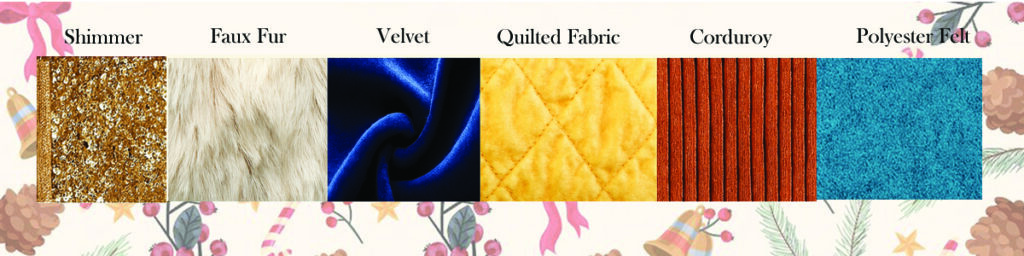
The tactile properties of a garment exhibit comfort and smoothness to our skin. Choosing the right fabric and textures for your garments sets your vibe and comfort. This year the trend voices out loud on use of soft 3D fabrics like Fur, Flannel and Velvets on one hand and shimmer and lurex on the other hand. In between lies a combination of playful textures and layering of fabrics to accentuate/emphasise the apparel’s structure.

  • Faux Fur (Soft 3-D texture)
  • Velvet (Luxurious Plush texture)
  • Quilted cotton & Polyester (fluffy 3D texture)
  • Brushed Flannel (Feathery tough texture)
  • Corduroy (Luxurious Plush texture)
  • Suede (Soft, Luxurious feel)
  • Faux Leather (Shiny, natural Soft and tough texture)
  • Brushed Polyester felt (Feathery soft texture)
  • Permanent Pleated Shimmer (glittery, soft and flouncy)
  • Sequin Fabric (3D Textured, Sheer fabric)

PRINTS AND PATTERNS

Winter Fashion 2025 fashion prints are characterized by bold and hyperreal flowers, nostalgic tapestry motifs, and richly textured vibrant stripes and check patterns. These prints have revived a hint of the retro era with shimmer disco trends, to check and geometric patterns to bold prints.

  • Hyperreal florals: Oversized, dreamy, and surreal.
  • Bold Animal Prints: Leopard, Cheetah, Tiger prints
  • Tapestry revival: Vintage carpets, stitched patch motifs.
  • Bold stripes: Retro clashes, dopamine dressing.
  • Geometric grids: Structured, checks, broken tartan, tech-inspired abstract.
  • Sequin & Sheer: Sparkle meets transparency.
  • Pastel Blooms: Soft, romantic, vintage vibes.

GARMENT SILHOUETTE

Winter 2025 fashion silhouettes expel all about relaxed baggy yet bold structure, fluid movement with playful layering of fabrics, and dramatic minimalism. Think of sculptural shapes, baggy still style fitted asymmetric cuts, and gender-fluid design and tailoring that fits well for both men and women as well as for boys and girls. This is the trend of this FALL-WINTER 2025-26

  • Sculptural cuts: Asymmetric cuts, off shoulder apparels, draped and angular hems.
  • Futuristic minimalism: Use of Clean lines and tech savy fabrics, use of shimmer and straight clean lines.
  • Dramatic Capes: Flared winter stylish capes with playful layering are a huge trend.
  • Fluid & genderless: Blurring the boundaries of gender, the cuts are relaxed, Oversized garments with bespoke/ custom tailoring.
  • Relaxed Baggy Denims: Baggy yet structurally fitted denims.
  • Flouncy layers: Flared pleated skirts, layered Sheer fabrics and romantic sequin dresses.
  • Elevated basics: Boxy denim blazers, wide legged trousers, cocoon dramatic oversized coats.

FASHION ACCESSORIES

Winter Fashion accessories 2025 trends exhibit BOLD INDIVIDUALITY. It is expected to visualise the above trends with layered jewelry, colorful trendy and sleek handbags, statement hairstyles and headwear, and smart wearables redefining everyday looks. These accessories are characterised by:

  • Sustainability: The use of Eco-friendly materials, utilization of scraps of materials and conscious production.
  • Maximalism: Use of bolder, Luxurious and most expressive pieces.
  • Tech Fusion: Fashion accessories with the use of smart gadgets.

The statement accessories that are seen on ramps along with the above listed category of garments are:

  • Layered Jewellery:
    • Stacked rings, chunky chain necklaces, and mixed metal accessories like brooches and bag charms
    • Personalization is huge: initials, charms, and DIY-inspired pieces
  • Statement Bags
    • Bright colours, playful shapes, small branded shoulder bags and oversized clutches
    • Sustainability focus: recycled materials and multifunctional designs
  • Headwear Revival
    • Baseball caps (Y2K-inspired) making a big comeback
    • Wide-brim hats and sculptural headpieces spotted on runways
  • Tech-Integrated Accessories
    • Smart rings, AR glasses, and wearable tech blending seamlessly with fashion
    • Accessories as both style and utility
  • Shoes as Accessories
    • Bold platforms, Loafers, Slouchy Boots, metallic finishes, and statement sneakers
    • Footwear doubling as the centrepiece of an outfit
  • Playful Scarves & Belts
    • Printed silk scarves styled as tops, oversized woolen scarves, oversized belts, or hair wraps
    • Wide belts cinching oversized silhouettes
  • Sustainable Sunglasses
    • Bio-acetate frames, tinted lenses in bold hues
    • Retro shapes like cat-eye and oversized round frames
  • Necklaces
    • Chunky Resin bead Necklaces


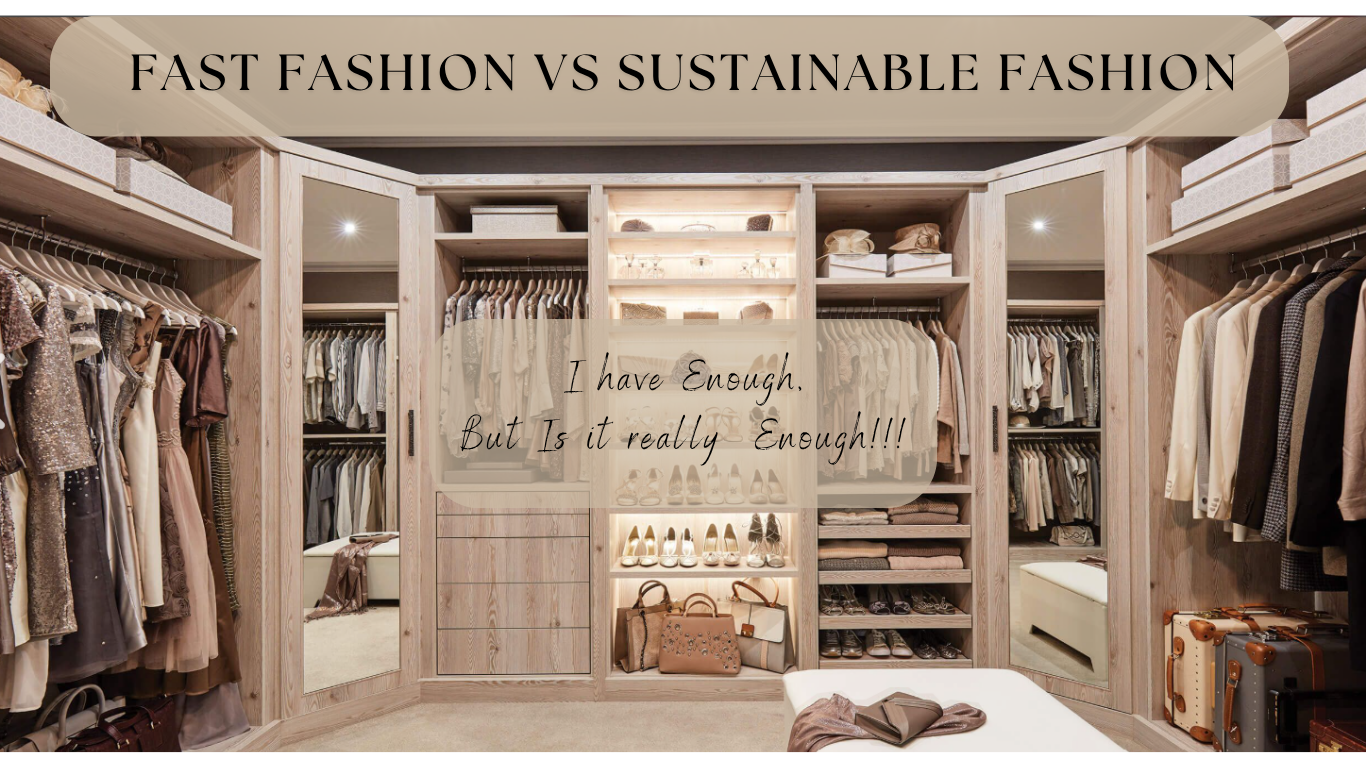
Fast Fashion VS Sustainable Fashion

Fast Fashion… What is it? Sustainable Fashion… What is it? Are we as consumers aware of these terms? What’s the hype! Why do we need to know about it? Why should we follow it?
Fast fashion are the trendy items, that we want or desire. It’s rarely out of need that we go in for buying Fast fashion. Is it not true, that whatever new and trendy enters the market goes viral? Why, because we all like it, but do we really “need” it? The answer is “NO”
Fast fashion is called so, because it refers to fashion items that have a quick turnover, are trendy, inexpensive garments. They meet the insatiable demands of consumers seeking up-to-the-minute trendy, in vogue styles.

The exact opposite is Sustainable fashion, the environmentally conscious practices involving from scratch to end, prioritizing longevity, high quality, and responsible sourcing.

FAST FASHION

There are a lot of trends that we see emerging in every season and every forecast. these trends are either set by authorised agencies like WGSN or by trend setters like movies, social media, influencers, designers etc. Yes, we all love to be fashionable, trendy, but why is fast fashion being opposed by most?

Fast fashion is a Garment and fashion accessories industry model built on producing trendy, inexpensive apparels, shoes. bags, belts, ties and other fashion accessories at rapid speed, often copying runway, cinema, social media, influencers or celebrity styles and pushing them into stores within a span of a few weeks, due to rise in demand.

While it makes fashion accessible and constantly refreshed, it relies on non-ecofriendly, inexpensive and low-priced inexpensive materials and cheap labor, leading to poor quality, short lifespans, and a culture of disposability. This cycle fuels overconsumption, generates massive textile waste, creates no reusability and contributes to pollution, while also raising concerns about exploitative working conditions.

Why is Fast Fashion being Opposed?

Fast fashion is being opposed because the manufacturing of fast fashion garments, from scratch to end, involves the use of non-environmentally friendly practices. From sourcing of cheap, non-biodegradable, easy to wear, crease resistant and easy maintenance fabrics ‘THE SYNTHETICS’ to the use of heavy machinery from pattern making, to cutting, to stitching and finally to finishing and packaging, leads to exorbitant amount of carbon footprint emission.

The fast fashion industry on one hand relies on cheap materials and rapid production, leading to massive textile waste, water pollution, and high carbon emissions, and on the other end, ‘SYNTHETIC FABRICS’ shed microplastics into oceans, which harms the life under sea, polluting the seas and the marine wildlife. At the same time, many workers in supply chains face unsafe conditions along with low wages. By encouraging disposable clothing and constant trend-chasing, fast fashion promotes overconsumption and undermines sustainability, sparking calls for more ethical, eco-friendly alternatives like sustainable fashion.

WHY IS FAST FASHION A BIG CONCERN OR A THREAT?

Fashion industry is globally the most polluting industry in the world today, due to use of fairly high amount of water during its processing. The highest amount of effluents in the form of toxic chemicals, gas emissions, dye run-offs and landfill due to excessive disposals has taken a toll on environmentalists, scientists, technologists and finally the government. This is a major concern for this generation, as the future is dependent on what we do, how we act and how we conserve our resources today!

Besides this, it also plays an important role in ensuring that the labour force is paid fairly, they are generally hired on per day basis, weather you get 10 garments made or 300 garments made per day, their wages remain the same. In the fast fashion industry, the labour is forced to work on a large number of pieces and gets paid less. This is one of the reasons for cheap price of fast fashion products. But ethically it is an extremely unfair practice.

It reduces the scope of innovation amongst consumers. The consumers tend to buy instead of experimenting with their existing fashion products and accessories. In today’s time, when styling tips are hovering all over the social media, one must make it a point to experiment and innovate rather than go for impulse buying.

Most of the fashion products, that go excess in the wardrobe, land in the landfills. We must make sure that we cultivate healthy and mindful buying practices. One must invest in high-quality pieces that last longer, go for designs that embody timeless styles, so your clothes do not go out of fashion quickly. Most of the sustainable brands are now producing such fashion accessories, hence, the more conscious we become, the better will be our future.


SUSTAINABLE FASHION

Sustainable fashion is the one that can sustain for years together, is environment friendly, during production as well as post disposal of products. It is a movement started for spreading awareness with an aim to protect and preserve our planet earth for years and generations to come. Sustainable fashion helps reduce environmental damage and supports fair labor practices.

Sustainable fashion is about making environmentally friendly choices, like reducing impulse buying behavior, investing on fast fashion, fast textile processing’s like use of chemical dyes and prints, avoiding the purchase of non-biodegradable fabrics, regarding the clothes you wear. It uses sustainable options like organic cotton, reused fabrics, and natural dyes.

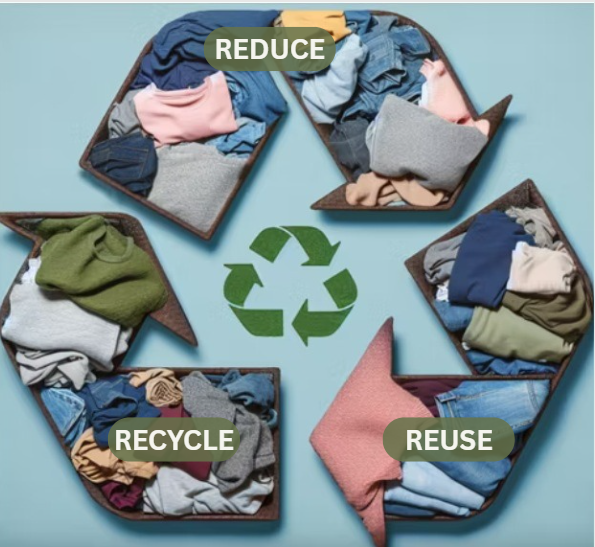
  • REDUCE the use of Non environment friendly products.
  • REUSE the fashion items you wish to throw away. For ex. Buttons, Patches of Prints, Dyes, Motifs, Accessories and fabric can be cut and stitched together to create a novel design garment.
  • RECYCLE the non-biodegradable products into new articles of day-to-day use, or there are organizations that are collecting fashion waste and recycling or upcycling them into new products.


SUSTAINABLE INDIAN FASHION BRANDS

Choose the Right Fabric for Every Garment Type

Choosing the right fabric/textile material bring a sketched design to life. It is the basic thing a designer must initially analyse. the correct textile material defines a garment/apparel’s drape, comfort, suitability, durability, ability to incorporate elements like patchwork, embroidery etc. Apart from this, it also helps us analyse its aftercare and launderability (washability). the correct choice of fabric also helps in understanding the season in which a garment can be worn. From the first pencil stroke on a sketchpad to the final stitch on a runway-ready piece, fabric is the soul of fashion.

As per the author's experience in teaching, evaluation of budding designers and interactions with other designer's world over, it was observed that the designers usually design a garment but are unable to select the perfect fabric to execute their collection. This turns into a huge disaster most of the times and even leads to downfall of their brands/couture house.
So, as a designer it is a must to know the basic knowhow of fabrics first and then land up designing a garment or a collection.

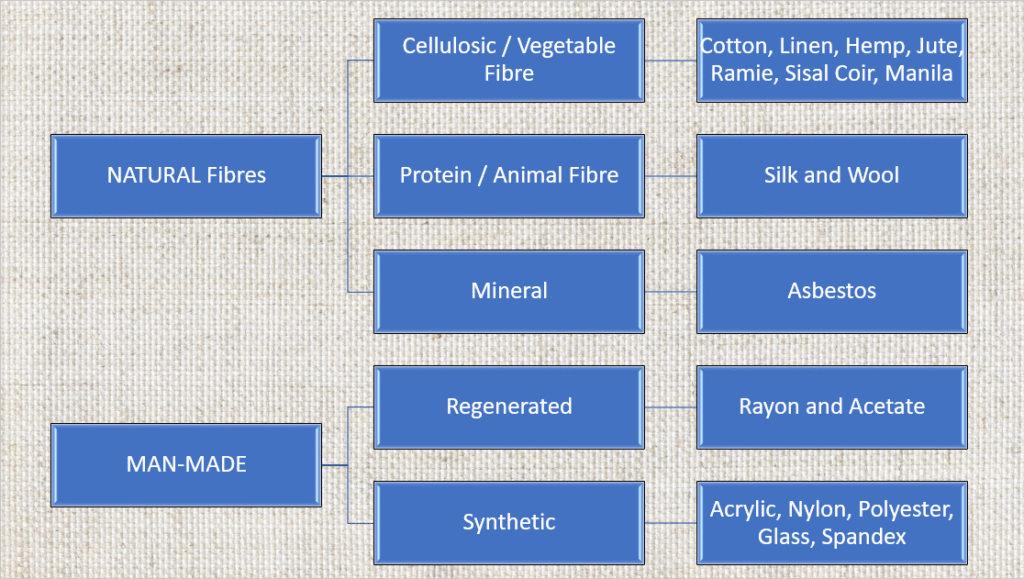
Going ahead and understanding the basic knowhows of a textile material, fabric is a sheet of fibres combined together by interloping, interlacing or bonding the fibres together. A fabric’s basic raw material is a fibre. Fibres used in manufacturing of textile fabrics, are either Natural in origin, or Manmade, or they can also be a combination of both natural and manmade fibres called Regenerated Fibres. Let’s dig a little deeper to understand how we decide on what kind of fabric to choose for what type of garment.

Natural Fibres are the ones, that we obtain from nature. Nature implies plants, animals and minerals.

  1. Plant fibres are obtained from stem, leaves, bark, fruit etc.
  2. Animal fibres are obtained from skin, hair, or secretions by the animals
  3. Mineral fibres are obtained from mineral deposits in the earth

The fibres available in the market from any of these sources are tested for their strength, pliability, durability, flexibility, texture, absorbency or moisture retention before being made or constructed into a fabric. they should have ample of strength, durability, pliability and flexibility to be made into a fashion garment/apparel. the texture should be such that it shouldn’t harm the skin, rather protect it from external factors like, cold, heat, wind, snow, ice, rain, dust etc. For comfort and climatic conditions, it should have the ability to absorb moisture. When we perspire/sweat, the sweat needs to be absorbed well by the fabric, to prevent any skin infection or allergenic reactions.

Qualities of Natural Fibres
  1. Natural fibers in general are hypoallergenic, extremely good for the skin and have high water absorbency.
  2. All cellulosic natural fibers can be given a tumble wash, until any dye or print is applied to it. these fibres gain almost double the strength in wet conditions, hence in day-to-day life, you may have observed that washing and wringing of cotton, linen etc. (the summer wear fabric) never destroys or damages the fabric.
  3. All Protein fabrics need to be dry cleaned as tumble wash or washing and wringing reduces their strength, makes the weak and prone to damages very quickly. They are wonderful fabrics for winterwear as their natural property is to trap and hold the body heat.

Man made fibres on the other hand are of two types:

  1. Regenerated: The ones which are made by mixing a natural fiber with a chemical in which it dissolves and is then made into a fabric eg Rayon and Acetate
  2. Synthetic fibres: The ones that are made by combining two or more different chemicals and then made into a fabric eg: Acrylic, Nylon, Polyester, Glass, Spandex/Lycra

These are called man-made fibres as they are manufactured in chemical laboratories or plants by mixing chemical compound that on cooling, solidify into fibres or yarns and are eventually made into fabrics.

Qualities of Man- Made Fibres
  1. All man-made fibres get weak when wet.
  2. All regenerated fibres like Rayon, Viscose, Tencel, Lyocell etc. absorb moisture, but less than the natural fibers and are mostly suitable for summer wear, during rainy season or in pleasant weather conditions. It is advised not to use them as undergarments or as lingerie wear as they can cause allergies or skin irritation.
  3. All synthetic fibers like Polyester, Nylon, Spandex etc. are hydrophobic and do not absorb much water. they are therefore used for making swimwear, fishing nets, winter wear jackets, as paddings for quilted garments, winter quilts etc.

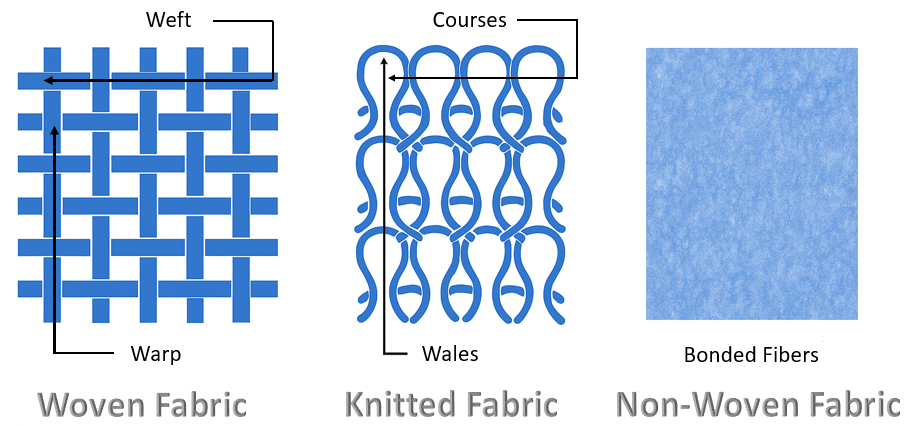
The fibres obtained from above sources, are made into yarns, the long strands of fibres combined together by the process of spinning. These yarns can be made thick or thin depending on the fabric to be constructed. For example, georgette needs a thin yarn for construction whereas denim needs a thick yarn. The thickness or thinness of a yarn determines the weight of a fabric called GSM (Gram per square meter). Higher the GSM, heavier the fabric, lesser the GSM, lighter the fabric. Another factor is the thread count of a fabric.  To understand the basics of thread count, it’s important to know the types of fabric and how each one is made. There are 3 ways to construct fabrics – interlacing, interloping and bonding the fibres together.

  • WOVEN FABRICS: Made by interlacing two sets of yarns, the lengthwise ones known as WARP and width wise, WEFT yarns at an angle of 90 degrees
  • KNITTED FABRICS: Made by interloping minimum one set of yarn. It has loops running in lengthwise direction, known as WALES and other in width wise direction, known as COURSES.
  • NON-WOVEN FABRICS: Made by bonding or entangling fibres with one another.

THREAD COUNT

Thread count can be calculated for woven fabrics by evaluating the number of yarns per square inch of a woven fabric. It is calculated by summing up the number of warp and weft yarns per inch of a woven fabric of any type or origin. For example, in a fabric if there are 133 warp yarns and 100 weft yarns, the thread count of that fabric will be 133+100 = 233TC.

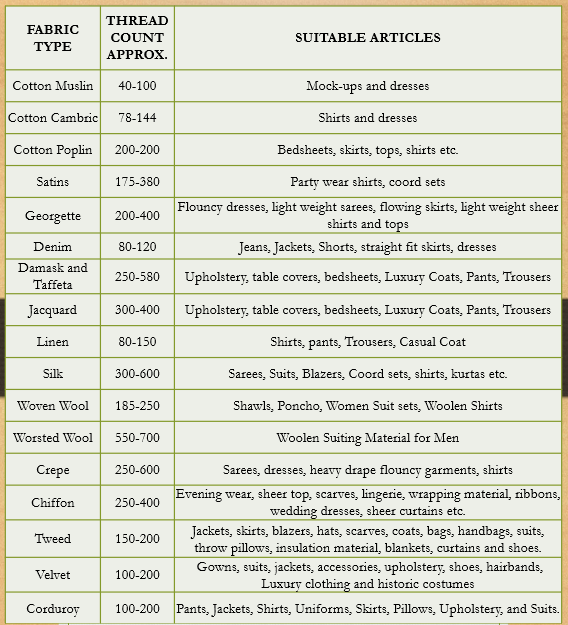
The fabrics can be made using any fibres, may they be natural or manmade. Thread counts are mostly mentioned on the, commercially on home furnishing fabrics like bedsheets, table covers, table mats, throws etc., but they are essential even while selecting fabrics for designing garments. While going out purchasing fabrics one can enquire for the thread count to match with their designed collection.

Mentioned here are some of the majorly used fabrics and their approximate average Thread count, available commercially

But it must be noted that it is not the only parameter that determines the quality of a fabric. The other factors are

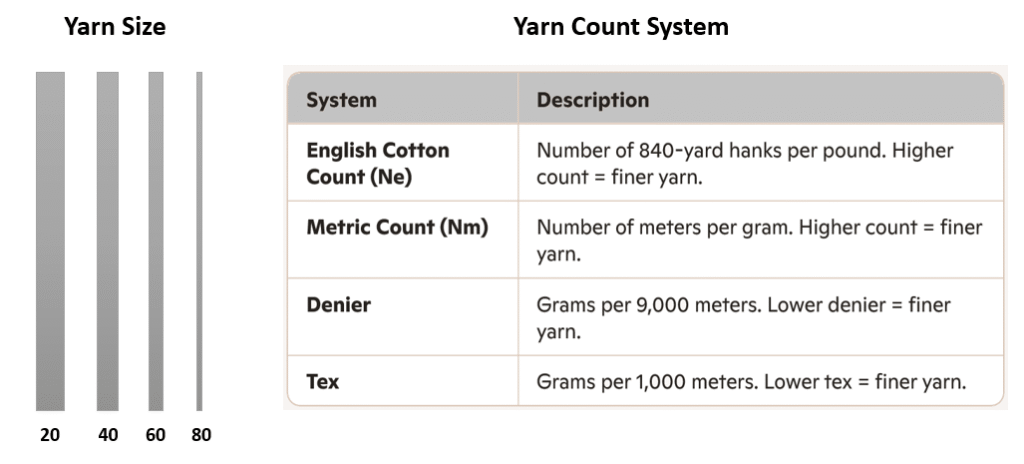
  • YARN SIZE – It determines the weight of a fabric, higher the yarn size, lighter the fabric. It is measured in two systems, namely Yarn Count System (It measures the length per unit weight of yarn) and Yarn Weight Category. The yarn count system is majorly used by fashion and textile industry and is measured in the unit Ne. So, a 50 Ne cotton yarn is finer than a 10 Ne yarn.
  • YARN QUALITY – It determines the longevity of the fabric. The better the origin, the longer will be the life of a fabric.
  • WEAVE – The more compact the weave, higher will be the thread count, more will be the strength and tougher will be the drape of the fabric.

Want to know more about Weaving, Knitting, Non-Wovens, Fabrics, Yarns or Fibres? Comment below

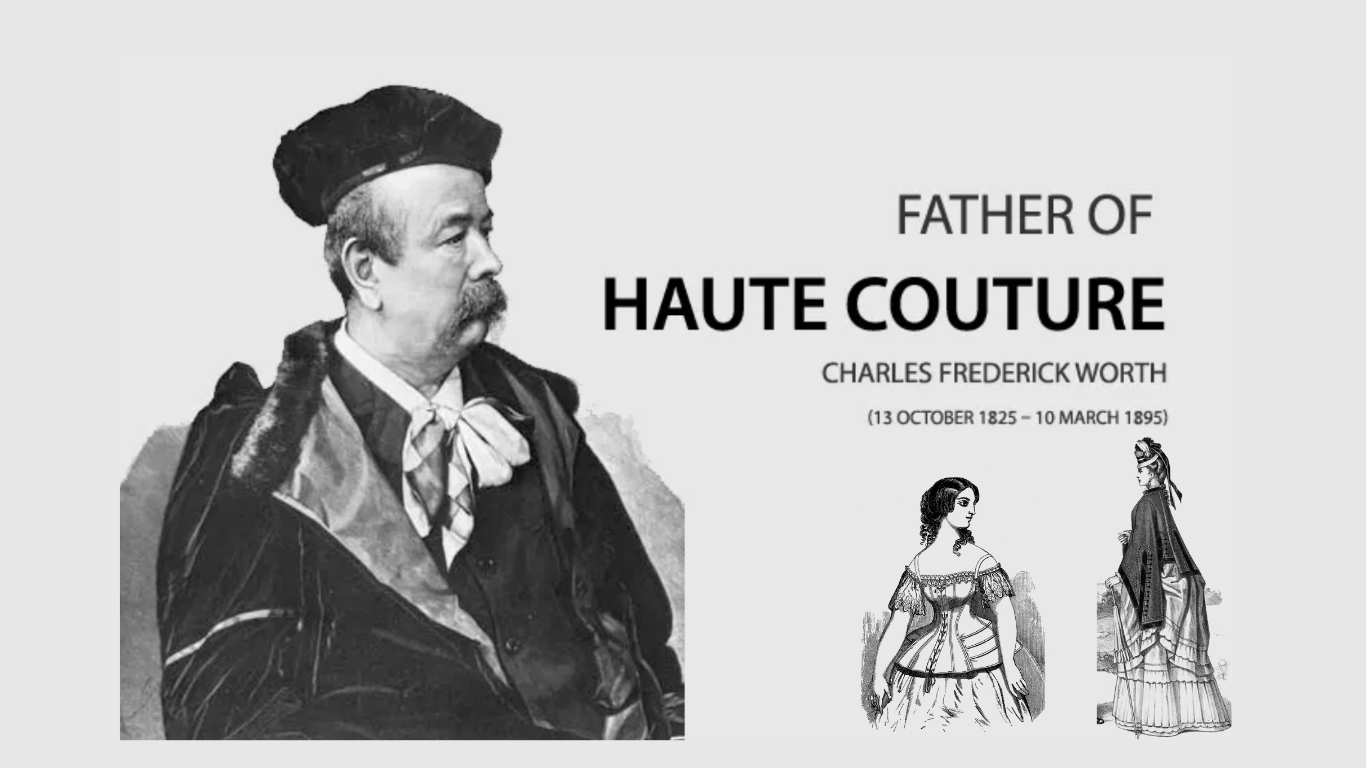
Haute Couture Legend: Charles Frederic Worth

THE FATHER OF HAUTE COUTURE
CHARLES FREDERIC WORTH

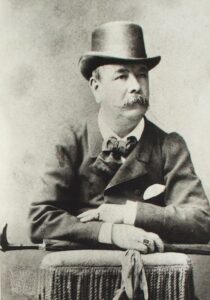
Charles Frederick Worth, the legendary designer, influenced Parisian fashion in the latter half of the nineteenth century, was born in Bourne, Lincolnshire, England, on October 13, 1825. Worth, as a young man, worked as an apprentice for London textile merchants. In addition to acquiring a thorough knowledge of fabrics and the business of supplying dressmakers during this time, he also visited the National Gallery and other collections to study historic portraits. He did so to get better inspiration for his own designs, for both fashionable ensembles and masquerade costumes. He was a great visionary designer who transformed 19th-century dressmaking into what we today call Haute Couture. From royal commissions and theatrical salons to his pioneering use of live models, seasonal collections, and designer labels, Worth’s influence is woven into the very fabric of the modern fashion industry. He is famously known as the ‘Father of Fashion’.

Struggles of Early Days 

Worth relocated to Paris in 1845. Despite early struggles, he found work in 1852, was working as a sales assistant at Gagelin-Opigez & Cie, a prominent firm that sold textile goods, fine cashmere shawls, and ready-made garments. Worth became Gagelin’s leading salesman and eventually opened a small dressmaking department for the company, his first position as a professional dressmaker, to compliment the shawls. Initially, the designs were very simple, but his expert tailoring caught the eye of the store’s clients. Eventually, Gagelin granted Worth permission to open an exclusive dress department, his first official entrance into the world of dressmaking. He contributed to the reputation of the firm with prize-winning designs displayed in the Great Exhibition in London (1851) and the Exposition Universelle in Paris (1855), where he had displayed a white silk court train embroidered in gold.

Worth’s rise as a designer coincided with the establishment of the Second Empire in France. The restoration of a royal house in 1852, with Napoleon III (1808–1873) as the new emperor, once again made Paris an imperial capital and the setting for numerous state occasions. Napoleon III demanded for luxury goods, including textiles and fashionable dress. His interests reached levels that had not been seen ever since, before the French Revolution (1789–99). When Napoleon III married Empress Eugénie (1826–1920), her tastes set the style at court. The empress’ patronage ensured Worth’s success as a popular dressmaker from the 1860s onward.

Worth’s designs were notable for his precise use of lavish fabrics and trimmings, his incorporation of elements of historic dress, and his attention to fit. While the designer still created one-of-a-kind pieces for his most important clients, he was exclusively known for preparing a variety of designs that were shown on live models at the House of Worth. Clients made their selections and had garments tailor-made in Worth’s workshop.

Charles Frederic Worth's Personal Life and Business Setup

Charles Frederic Worth acquired a young Swedish business partner, Otto Gustaf Bobergh, and in 1858 the duo set up in business at 7 rue de la Paix, naming the establishment Worth and Bobergh. Marie Vernet Worth met Charles, while both were working at Gagelin, Marie was the very first model in the world of fashion, Charles was a designer. They fell in love with each other. Their relationship encompassed both personal and occupational ties—he was her spouse, and she represented his revolutionary designs to the customers by walking through aisle at their Couture House. During an era when fashion was transitioning from the unnamed work of seamstresses to recognized artistry, Worth’s concept of a designer-centric house necessitated a public persona who could personify his works. Vernet fulfilled that role, and discussed the problems faced by females, while wearing restrictive clothing.

Charles during his reign as a designer, at a smooth, slow and steady pace, eased out restrictive clothing. He did so by introducing – additional flaring techniques like gathering the fabric, pleating it in various ways and also by adding layers of clothing.

"The dress must follow the body of a woman, not the body following the shape of the dress."
The Origin of Haute Couture

Although Worth was not the first or only designer to organize his business in this way, his aggressive self-promotion, dedication, interests and fine workmanship earned him the titles “Father of Haute Couture” and “the first couturier.” By the 1870s, Worth’s name frequently appeared in ordinary fashion magazines, spreading his fame to women beyond courtly circles.

Haute Couture is a French phrase for most elevated, Highest-Level Fashion. It refers to high dressmaking or finest sewing. It is created with the highest quality needlework and craftsmanship. It exhibits the most fashion forward, exclusive, elated level styles, color combinations and silhouettes, but in the world of fashion, it’s a fiercely protected, exclusive, and legally regulated title.

The origins of Haute Couture are accredited to Charles Frederick Worth who, in 1858 founded the first true Couture House at number 7, Rue De La Paix in Paris. Marie-Antoinette was the last queen of France. Before 1858, Rose Bertin, Marie-Antoinette’s Fashion Minister, had foreshadowed it, being the first to start freeing up the female body, all the while adorning her creations with embroidery, lace and rose petals. That era was known as the Victorian Era, and was characterised by restrictive fashion components. Some of those garments were Crinoline, Crinolette, Back Bustles, Corsets etc.

In France, the term Haute Couture is protected by law. These laws are defined by the Fédération de la Haute Couture et de la Mode, the organization based in Paris. At the origins of the Federation lies the Chambre Syndicale de la Haute Couture. Founded in 1868 and then known as the Chambre Syndicale de la Couture, des Confectionneurs et des Tailleurs pour Dame (Chambre Syndicale for Couture, clothing manufacturers and tailors for women), it became the Chambre Syndicale de la Couture Parisienne on December 14th 1910. Following the decision taken on January 23rd 1945, relating to the creation of the legally registered designation of origin ” Haute Couture “, it became the Chambre Syndicale de la Haute Couture. The only institutions to serve here are the ones that have received the designation, which those companies approved each year by a dedicated commission held under the aegis of the Ministry for Industry may become eligible for. On June 29th 2017, it became the Fédération de la Haute Couture et de la Mode. Following a decision, on January 23rd 1945, the designation Haute Couture became a legally registered designation of origin.

Only those houses and companies that are approved each year by a dedicated commission run by the Chambre Syndicale de la Couture and held under the aegis of the Ministry for Industry may become eligible for it.


The Rise of Indian Fashion

India has never lost touch with its roots. Even as modernization revolves round the globe, our fashion still continues to exuberate grace, subtlety and sustainability.

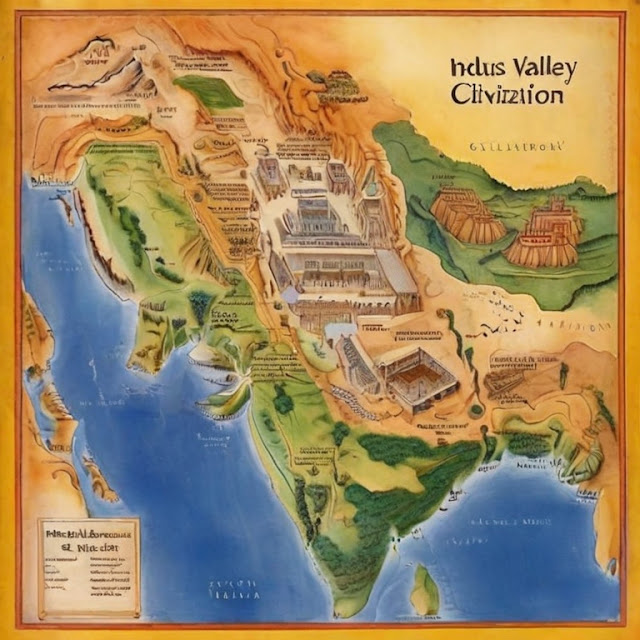
Fashion evolution in India started with the invent of Cotton Fiber. Long back, around 2500 BC, a civilization flourished in India namely Indus Valley civilization also known as Harrapan Civilization.

It flourished in the Valley near Indus River. The region extended from Manda (Jammu and Kashmir) in the north to Daimabad (Maharashtra) and from Alamgirpur (Uttar Pradesh) in the east to Pakistan (Sutkagan Dor) in the west.

This civilization was also known as the bronze age civilization and many bronze articles have been excavated from the sites of this civilization.

Indus valley civilization excavation and remains show traces of cotton cultivation and it being used as textile material and also for the purpose of trade. The civilization flourished between 3300–1300 BCE and was the first civilizations to carry out plantation of cotton plants and develop techniques for spinning and weaving it into a fabric.

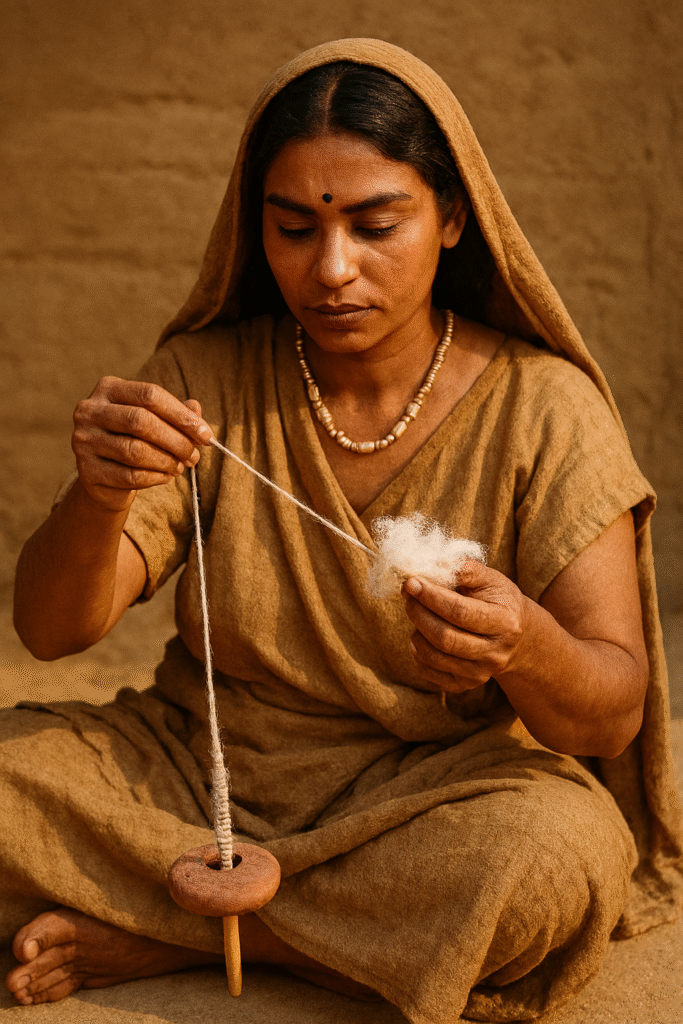
Excavations at the Harrapan cites shows remains of spindle whorls or takli, made of clay, terracotta, stone, and metals like bronze. This was a tool developed by Harrapans for spinning cotton fibres into yarns.

People wore hand-spun cotton garments dyed with natural indigo, showcasing early textile craftsmanship.

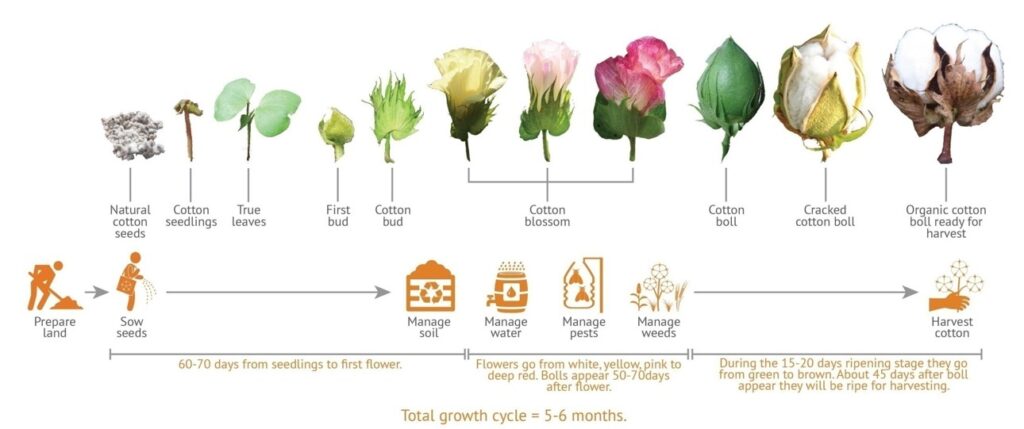
Cotton a plant fiber obtained from the SEEDS of KAPOK Plant, grown on black soil and the favourable climatic conditions prevalent in India. The process of cotton processing carried out in factories now a days, is done by machinery and is as follows:

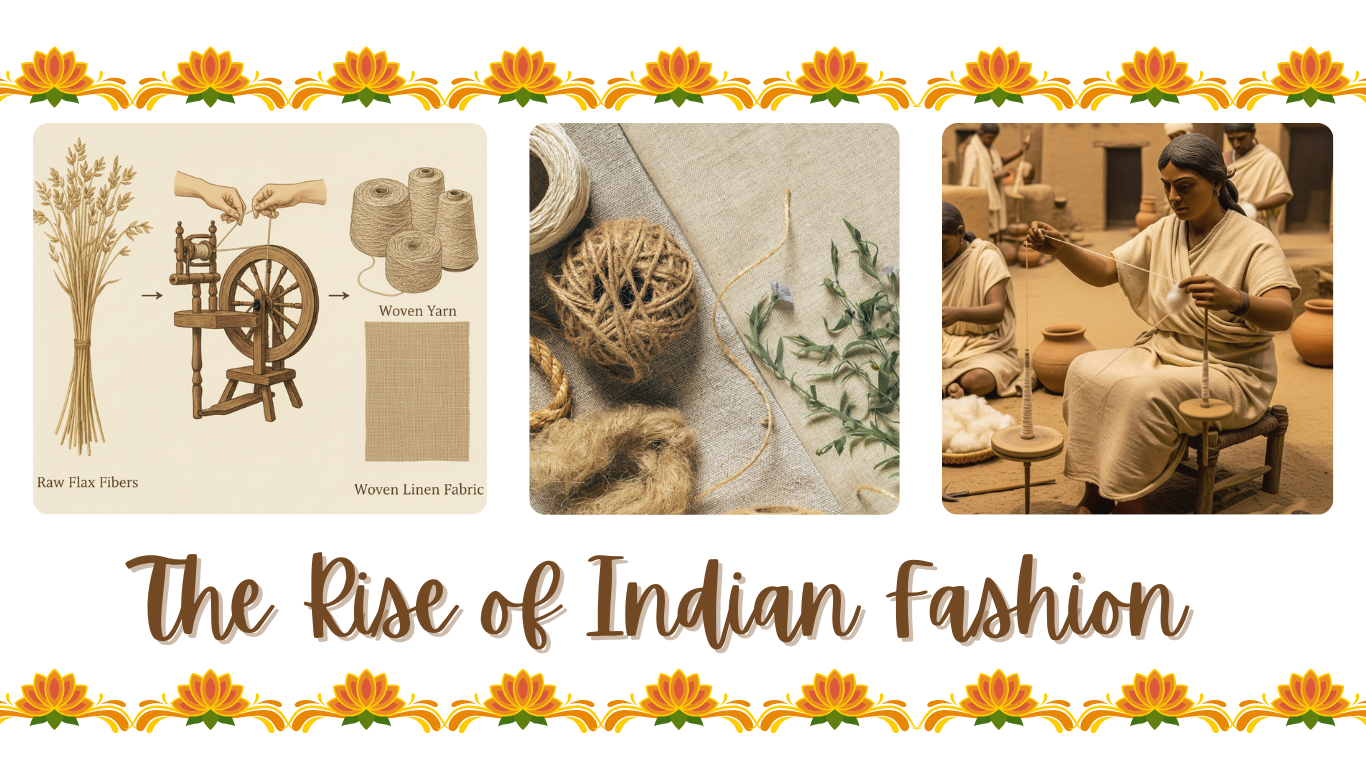
The ancient method of processing of fibre was carried out manually, from Ginning that is plucking seed Fibre to the process of Drawing and Roving. After roving, the fibres cling to one another in the form of a fluffy thick rope known as sliver. The final step of spinning was done by spindle whorls or takli (refer to the video attached). After spinning, the yarns were woven into a fabric. India, China, Peru and Egypt were the main areas of cultivation of cotton in those primitive times.


Evolution of Cotton Cultivation, Processing & Production from then till now...

Ranging from primitive, ancient times, till medieval centuries, India became renowned for its fine cotton textiles—Muslin from Bengal, Chintz from Gujarat, and Calico from the Coromandel Coast, the eastern coastal belt of India. Cotton cultivation expanded across fertile regions, and spinning and weaving were largely artisanal, done by hand using tools like the charkha. These textiles were major exports, traded across Asia, the Middle East, and Europe.

Then came the time of Colonial Era, where British colonization drastically altered India’s cotton economy. The East India Company, established by Britishers, turned India into a supplier of raw cotton for British mills, undermining indigenous handloom industries. Mechanized mills were introduced by them in cities like Bombay and Ahmedabad, but they primarily served colonial interests. Traditional artisans thereby faced deindustrialization, and cotton processing hence shifted from decentralized village systems to urban industrial hubs.

When Indian government and majorly, Gandhiji understood the aim of British East India Company, the Swadeshi movement commenced. It thereby revived interest in indigenous cotton production and hand-spinning, symbolized by Mahatma Gandhi’s use of the charkha. This era saw a resurgence of cottage industries and a push for self-reliance. By 1947, India had a mix of handloom and mechanized cotton sectors, laying the foundation for post-independence industrialization.

At independence, India inherited a broken cotton landscape. Most of the fertile cotton-growing land had gone to Pakistan, leaving behind just 4.42 million hectares. The early decades focused on self-sufficiency, with government-led initiatives to revive cotton farming and support handloom sectors. The Cotton Corporation of India (CCI) was established in 1970 to stabilize prices and to support farmers.

The introduction of hybrid cotton varieties, notably the H-4 strain in 1970, marked a turning point. The H-4 cotton strain, also known as Hybrid-4 or Sankar-4, was a groundbreaking development in Indian agriculture. Released in 1970 by Dr. Chandrakant T. Patel at the Surat Cotton Research Station of Gujarat Agricultural University, it was the world’s first commercial cotton hybrid. These seeds improved yield and fibre quality, enabling India to expand its textile base. Mechanized spinning mills flourished in cities like Ahmedabad and Coimbatore, while handlooms continued to serve rural economies. However, productivity remained uneven due to rain-fed farming and limited irrigation.

In 2002, India approved Bt cotton—a genetically modified variety resistant to bollworms. This led to a dramatic increase in yields and reduced pesticide use, with Bt cotton covering over 90% of cotton farms by 2014. Cotton production surged, making India the world’s largest cotton producer. Yet, over-reliance on a single technology brought new challenges: pest resistance, soil fatigue, and declining biodiversity.

Recent years have seen a shift toward climate-resilient farming, organic cotton, and regenerative practices. Drip irrigation, precision agriculture, and AI-driven crop monitoring are slowly gaining ground. Despite technological strides, only 30–33% of farms use modern irrigation, and smallholder farmers still face credit and market access issues. The rise of ethical fashion and global sustainability standards has pushed Indian cotton producers to rethink fibre quality, traceability, and eco-certification.

From hand-spun yarn to automated ring spinning, India’s cotton processing has undergone a huge change. Today, the country hosts over 1,500 processing mills, 7 million power looms, and 4 million handlooms. Innovations in dyeing, printing, finishing, texturization and blending have enabled Indian cotton fabrics to compete globally—across fashion, home textiles, and technical applications.

India’s cotton story is not just about fiber—it's about farmers, artisans, technologists, and storytellers. As the industry embraces sustainability and digitization, the challenge lies in balancing tradition with transformation. Cotton remains a symbol of India’s enduring spirit—rooted in soil, spun with purpose, and stitched into history.

Fashion Forecasting: How to predict or spot fashion trends?

Future Fitz: The Art & Tech of Future Forecasting

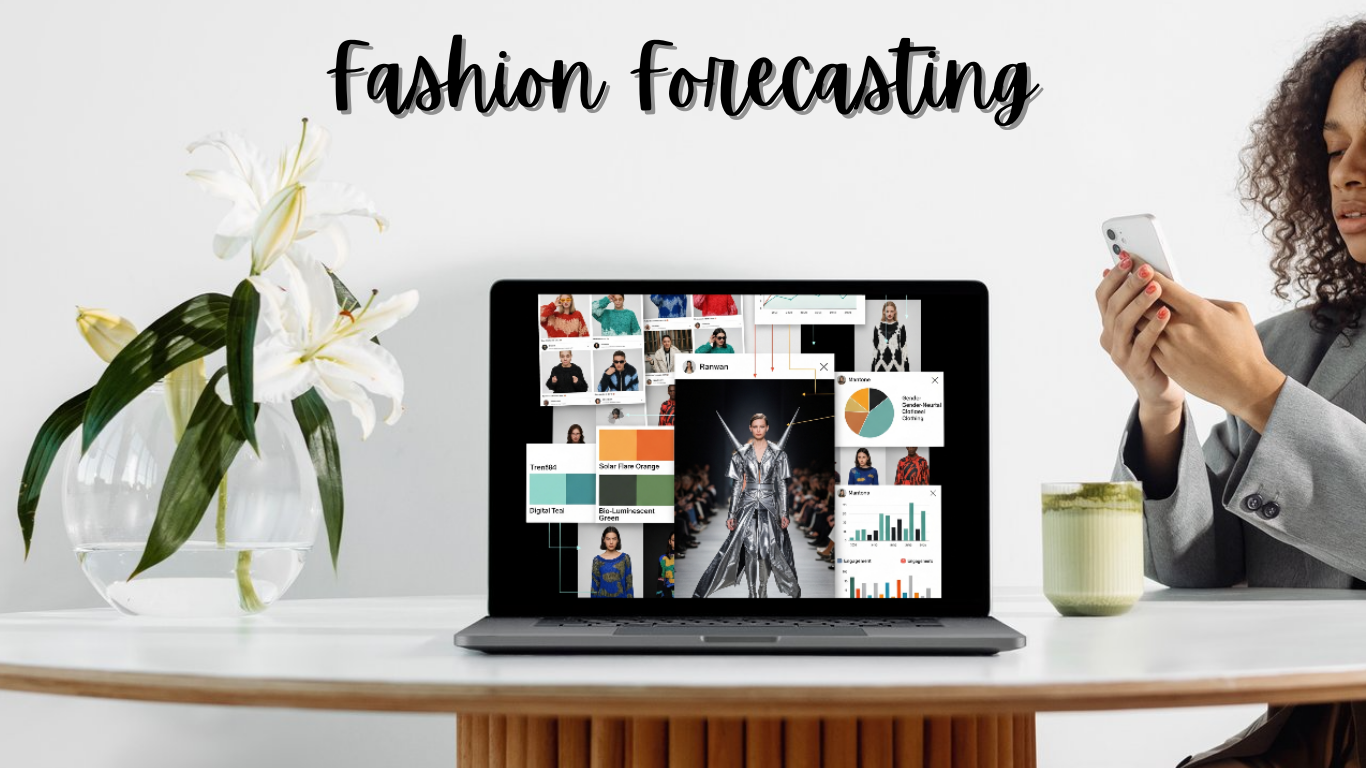
Ever wonder how brands know we’re all about oversized blazers one season and micro-minis the next? It’s not magic, it’s a whole vibe—and a serious science. Welcome to the world of fashion forecasting. It’s the secret sauce that keeps the fashion industry a step ahead, predicting what we’ll be wearing, loving, and obsessing over before it even hits the racks.

At its core, fashion forecasting is the art of predicting future trends. It’s a mix of cultural instinct, creative insight, and hardcore data analysis that helps designers and brands figure out what colours, silhouettes, fabrics, and styles are about to blow up in the coming FASHION SEASON. It’s not just about clothes; it’s about predicting society’s mood and consumer behaviour. Fashion forecasting is like being a style detective, a trend-spotting psychic who uses data and gut feeling to predict what’s next. From the runway to the streets, social media, and even global events. It’s a complex, multi-layered process that’s part art, part science. Here’s how it all goes down:

1. The Deep Dive: Research and Data Analysis: Before a single design sketch is made, forecasters are out there, gathering intel from every corner of culture. They don’t just look at what’s hot right now; they’re analysing what’s bubbling up from the streets, what’s a subtle shift on social media, and what macro-trends (like sustainability or the rise of AI) are shaping society. This isn’t just about looking at pretty pictures—it’s about crunching numbers. They’re tracking sales data, search engine queries, and social media analytics to get a clear picture of what consumers are actually interested in.

2. The Creative Mashup: Mood Board & Trend Identification: Once the data is in, the magic begins. Forecasters start to connect the dots, clustering their findings into key themes. This is where the mood board comes to life. It’s a visual story that brings together color palettes, fabric swatches, textures, and key silhouettes. They’ll pull inspiration from everything—a viral TikTok dance, a trolling social media feed, hashtags, visuals, a piece of avant-garde art, or a cultural moment that’s sparking conversation. These mood boards are more than just a collage; they’re the DNA of a future collection, a visual guide that tells a compelling story.

3. The Storytelling: Communicating the Forecast: The final step is translating all of this research and creativity into a clear, actionable forecast. This often takes the form of a detailed trend report. It’s a comprehensive guide that not only shows what’s coming but also explains why. These reports are the roadmap for the entire fashion pipeline—from designers who need to know what to create, to manufacturers who need to source materials, to retailers who need to stock their shelves. It’s the ultimate plan to ensure the right products get to the right people at the right time.

Ultimately, the process of fashion forecasting is what keeps the industry moving forward, pushing us beyond the trends of yesterday and into the styles of tomorrow. It’s a dynamic, ever-evolving process that’s more relevant than ever in our hyper-connected world.

Sources That Slay the Trend Game

So now that you have got the lowdown on the fashion forecasting process. Now, where do the pros—and the brands you love—get their intel? Forget the crystal ball; we’re diving into the real sources that tell us what’s next.

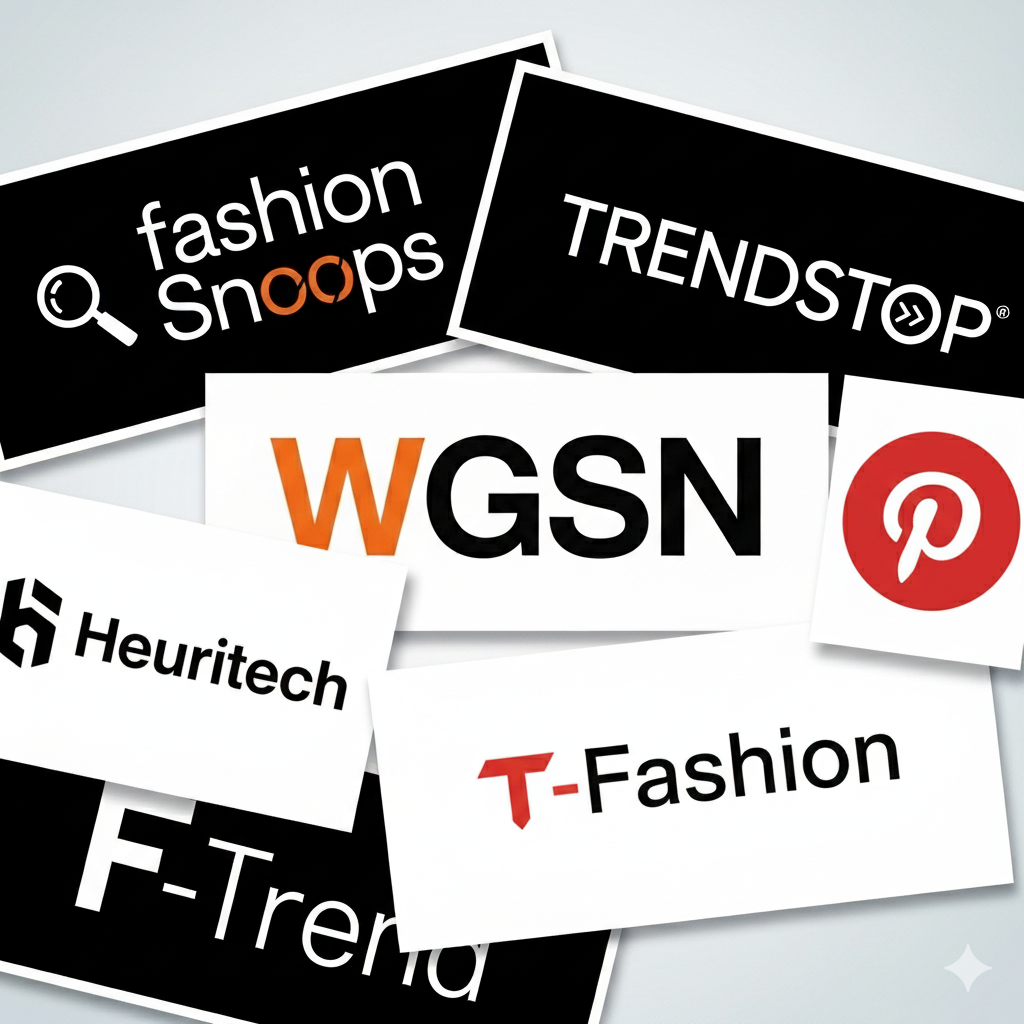
  1. The Industry Powerhouses (The Paid-For Forecasts): These are the big leagues, the platforms that fashion schools, designers, and major corporations pay big bucks to access. They’re a goldmine of data and analysis.

WGSN (Worth Global Style Network): The OG. They’ve been around forever and are basically the Wikipedia of trend forecasting. They predict everything from colours and prints to consumer behaviour years in advance.

Fashion Snoops: Known for their deep-dive, creative trend reports. They’re all about the vibe and the story behind a trend, blending cultural insights with commercial viability.

Trendstop: This one’s all about real-time trend intelligence. They are super-fast, delivering insights on fashion, beauty, and lifestyle to help brands stay ahead of the curve.

F-trend: They map trends across 19 clothing categories and accessories, focusing on consumer behaviour and providing regional insights.

2. AI-Powered Trend Detectives: The future is now! These platforms use AI to scan billions of images and data points to give a scientific edge to forecasting.

  • Heuritech: They use AI to analyze what people are actually wearing on social media and the runways, giving brands a data-driven look at what’s rising and what’s on the decline.
  • T-Fashion: A full-stack AI platform that provides real-time trend data, helping designers research, create, and collaborate at lightning speed.

3. The Free & Fierce Resources (Your Vibe Check): For the upcoming generation, the digital natives, a lot of forecasting happens on the social media feeds. You can get a legit head start just by paying attention.

  • Pinterest Predicts: Pinterest’s annual report is fire. They track what’s blowing up on the platform and predict what’s going to be big next year. It’s a goldmine for aesthetic inspiration.
  • Instagram: The birthplace of micro-trends. Watch what’s going viral—the core aesthetics, the styling hacks, and the Do-it-Yourself (DIYs). Pay attention to everything from how people are layering to the color palettes that are taking over your FYP (For-your-Page).
  • Google Trends: This is your data playground. You can search for any term—’Quiet Luxury,’ ‘Goth‘, ‘Retro‘, ‘Balletcore,’ ‘Gorpcore‘—and see its popularity over time. It’s a literal graph of a trend’s life cycle.
DROP YOUR VIBE IN THE COMMENTS 

What’s a micro-trend you’re seeing everywhere right now that you think is about to become a major moment? Is it the return of low-rise jeans? The rise of crochet accessories? Let us know what you’re predicting!

#FashionForecasting #SustainableStyle #FutureFits #Trendsetter

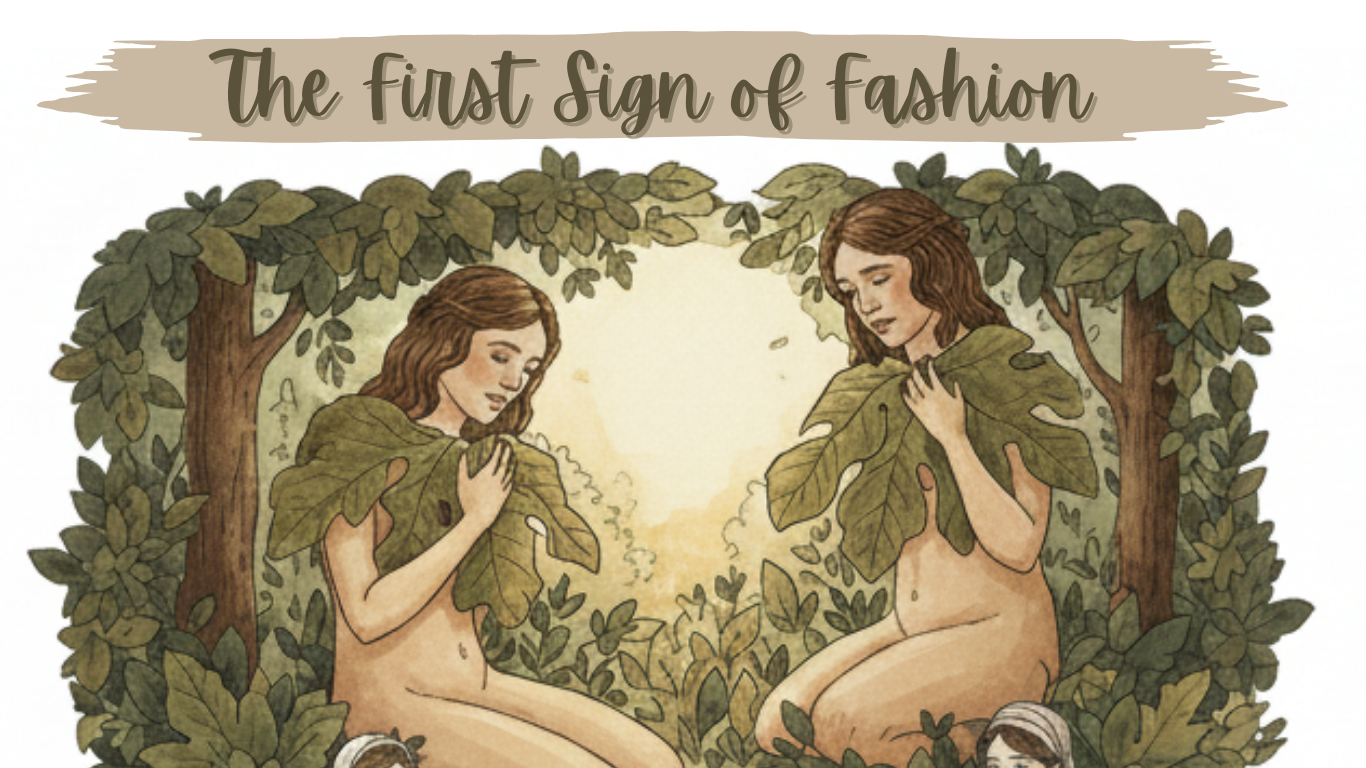
The First sign of Fashion: A History of Modesty and its Origin

‘Fig leaf to First fabric- Fashion, a pure need and Necessity’

Fashion in today’s time has evolved as a way of self-expression, but thousands of years ago, fashion originated as a blend of basic need and survival. It began with the prime need to shield the skin against harsh climatic conditions like heat, cold, dirt, dust, snow, rain etc. and was so known by the name ‘Second Skin’. The Bible too Reads:

“And the eyes of Adam and Eve opened, they saw that they were naked, so they sew Fig Leaves together, and made themselves Aprons”

So, earlier animal skin, fur, fig leaves, barks of trees etc. were the only form of clothing used to protect oneself from harsh climatic condition. Going even before this time… people used to adorn their bodies with paint, shells, beads, feathers etc.

Fashion evolved with evolution of Civilizations. By the beginning of bronze age, as studied by archeologists, world over, traces of woven fabric from natural fibers could be seen in the remains of the civilized sites. The Egyptians were the ones to discover a fiber first that was later converted into a fabric, near around 2000 BC. That fiber was fine LINEN, obtained from the stem/bast of the Flax Plant, and is widely used as a Trendy summer wear fabric even today. (Image Source: camixa.com).

Brands like H&M, Zara, Arrow, Raymonds and many others are manufacturing ready-to-wear garment collections using linen. It is a highly sustainable fiber and hence is a proven eco-conscious fiber. Eco-conscious fibers are the ones that minimize environmental impact throughout their lifecycle from sowing of seed to production to consumption and finally disposal.

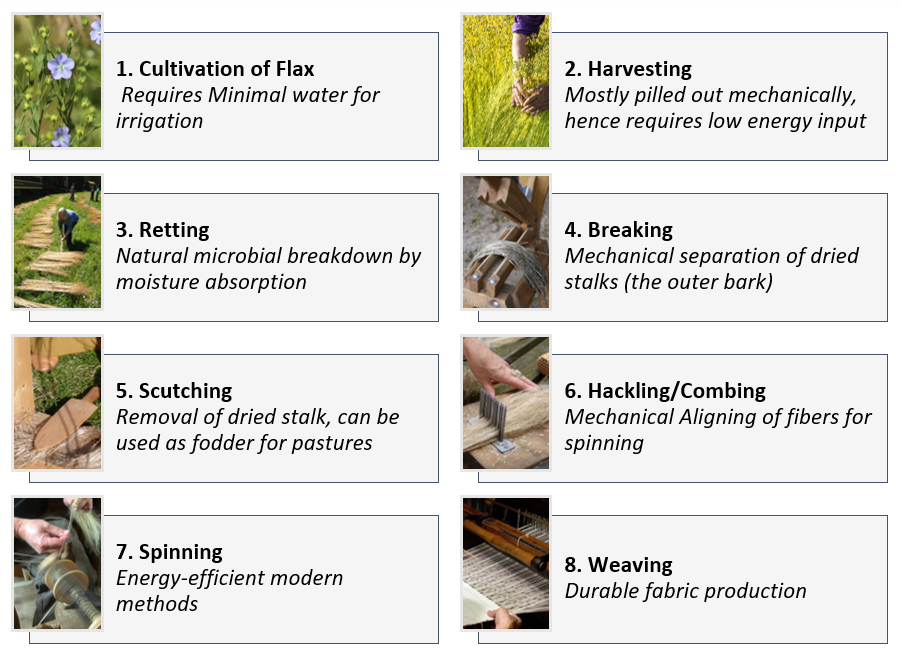
Flax fibers are amongst the oldest grown fibers on earth, known to mankind. Flax plan grows in dry and hot climatic condition. Egypt being very near to equator since ancient times, had the appropriate climatic condition for flax plant to grow. It’s generally a 2-4 feet long plant that has the strong, flexible fibers running in its stalk/ stem/ bast till the root tips. It is hence uprooted or pulled from the soil to process it into a fiber. The processing of linen’s lifecycle is shown in the chart.

Each step stated in the chart uses manual or light mechanical procedure, in ancient times there were neither power generated machineries (a major source of carbon footprint today) nor were there technological sound instruments. Today we stand at the crossroads of innovation, sustainability and inclusivity. Fashion redefines itself everyday —not just as a form of expression, but also as a force to bring about change. The yarns of the past have woven an opulent tapestry, but the future of fashion belongs to this generation, to innovate with intention, creativity, and conscience. Let’s pledge to use fashion in a sustainable way, buy consciously, buy less, use eco-conscious fibers like Linen, Cotton, Hemp, Jute, Ramie, Sisal, Coir, Manila, Bamboo, Silk, Wool, organic fibers and all natural sources.

“Fashion is no longer just stitched in a fabric—it’s embroidered with ethics, coded with tech, and dyed in the colors of change. Let’s not just wear fashion—let’s shape it with Sustainably and inclusively”


RSS
Follow by Email
Instagram
Telegram
WhatsApp