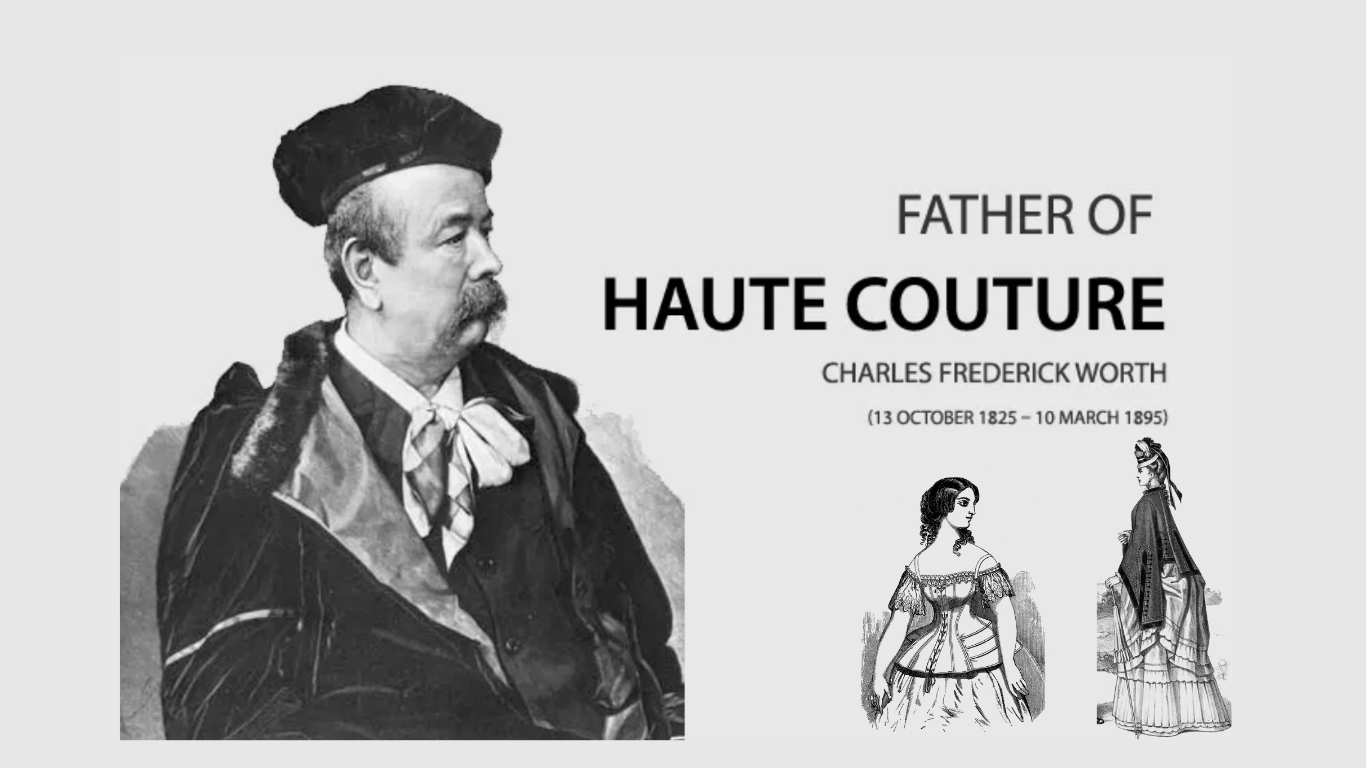
THE FATHER OF HAUTE COUTURE
CHARLES FREDERIC WORTH
Charles Frederick Worth, the legendary designer, influenced Parisian fashion in the latter half of the nineteenth century, was born in Bourne, Lincolnshire, England, on October 13, 1825. Worth, as a young man, worked as an apprentice for London textile merchants. In addition to acquiring a thorough knowledge of fabrics and the business of supplying dressmakers during this time, he also visited the National Gallery and other collections to study historic portraits. He did so to get better inspiration for his own designs, for both fashionable ensembles and masquerade costumes. He was a great visionary designer who transformed 19th-century dressmaking into what we today call Haute Couture. From royal commissions and theatrical salons to his pioneering use of live models, seasonal collections, and designer labels, Worth’s influence is woven into the very fabric of the modern fashion industry. He is famously known as the ‘Father of Fashion’.
Struggles of Early Days
Worth relocated to Paris in 1845. Despite early struggles, he found work in 1852, was working as a sales assistant at Gagelin-Opigez & Cie, a prominent firm that sold textile goods, fine cashmere shawls, and ready-made garments. Worth became Gagelin’s leading salesman and eventually opened a small dressmaking department for the company, his first position as a professional dressmaker, to compliment the shawls. Initially, the designs were very simple, but his expert tailoring caught the eye of the store’s clients. Eventually, Gagelin granted Worth permission to open an exclusive dress department, his first official entrance into the world of dressmaking. He contributed to the reputation of the firm with prize-winning designs displayed in the Great Exhibition in London (1851) and the Exposition Universelle in Paris (1855), where he had displayed a white silk court train embroidered in gold.
Worth’s rise as a designer coincided with the establishment of the Second Empire in France. The restoration of a royal house in 1852, with Napoleon III (1808–1873) as the new emperor, once again made Paris an imperial capital and the setting for numerous state occasions. Napoleon III demanded for luxury goods, including textiles and fashionable dress. His interests reached levels that had not been seen ever since, before the French Revolution (1789–99). When Napoleon III married Empress Eugénie (1826–1920), her tastes set the style at court. The empress’ patronage ensured Worth’s success as a popular dressmaker from the 1860s onward.
Worth’s designs were notable for his precise use of lavish fabrics and trimmings, his incorporation of elements of historic dress, and his attention to fit. While the designer still created one-of-a-kind pieces for his most important clients, he was exclusively known for preparing a variety of designs that were shown on live models at the House of Worth. Clients made their selections and had garments tailor-made in Worth’s workshop.
Charles Frederic Worth's Personal Life and Business Setup
Charles Frederic Worth acquired a young Swedish business partner, Otto Gustaf Bobergh, and in 1858 the duo set up in business at 7 rue de la Paix, naming the establishment Worth and Bobergh. Marie Vernet Worth met Charles, while both were working at Gagelin, Marie was the very first model in the world of fashion, Charles was a designer. They fell in love with each other. Their relationship encompassed both personal and occupational ties—he was her spouse, and she represented his revolutionary designs to the customers by walking through aisle at their Couture House. During an era when fashion was transitioning from the unnamed work of seamstresses to recognized artistry, Worth’s concept of a designer-centric house necessitated a public persona who could personify his works. Vernet fulfilled that role, and discussed the problems faced by females, while wearing restrictive clothing.
Charles during his reign as a designer, at a smooth, slow and steady pace, eased out restrictive clothing. He did so by introducing – additional flaring techniques like gathering the fabric, pleating it in various ways and also by adding layers of clothing.
"The dress must follow the body of a woman, not the body following the shape of the dress."
The Origin of Haute Couture
Although Worth was not the first or only designer to organize his business in this way, his aggressive self-promotion, dedication, interests and fine workmanship earned him the titles “Father of Haute Couture” and “the first couturier.” By the 1870s, Worth’s name frequently appeared in ordinary fashion magazines, spreading his fame to women beyond courtly circles.
Haute Couture is a French phrase for most elevated, Highest-Level Fashion. It refers to high dressmaking or finest sewing. It is created with the highest quality needlework and craftsmanship. It exhibits the most fashion forward, exclusive, elated level styles, color combinations and silhouettes, but in the world of fashion, it’s a fiercely protected, exclusive, and legally regulated title.
The origins of Haute Couture are accredited to Charles Frederick Worth who, in 1858 founded the first true Couture House at number 7, Rue De La Paix in Paris. Marie-Antoinette was the last queen of France. Before 1858, Rose Bertin, Marie-Antoinette’s Fashion Minister, had foreshadowed it, being the first to start freeing up the female body, all the while adorning her creations with embroidery, lace and rose petals. That era was known as the Victorian Era, and was characterised by restrictive fashion components. Some of those garments were Crinoline, Crinolette, Back Bustles, Corsets etc.
In France, the term Haute Couture is protected by law. These laws are defined by the Fédération de la Haute Couture et de la Mode, the organization based in Paris. At the origins of the Federation lies the Chambre Syndicale de la Haute Couture. Founded in 1868 and then known as the Chambre Syndicale de la Couture, des Confectionneurs et des Tailleurs pour Dame (Chambre Syndicale for Couture, clothing manufacturers and tailors for women), it became the Chambre Syndicale de la Couture Parisienne on December 14th 1910. Following the decision taken on January 23rd 1945, relating to the creation of the legally registered designation of origin ” Haute Couture “, it became the Chambre Syndicale de la Haute Couture. The only institutions to serve here are the ones that have received the designation, which those companies approved each year by a dedicated commission held under the aegis of the Ministry for Industry may become eligible for. On June 29th 2017, it became the Fédération de la Haute Couture et de la Mode. Following a decision, on January 23rd 1945, the designation Haute Couture became a legally registered designation of origin.
Only those houses and companies that are approved each year by a dedicated commission run by the Chambre Syndicale de la Couture and held under the aegis of the Ministry for Industry may become eligible for it.